
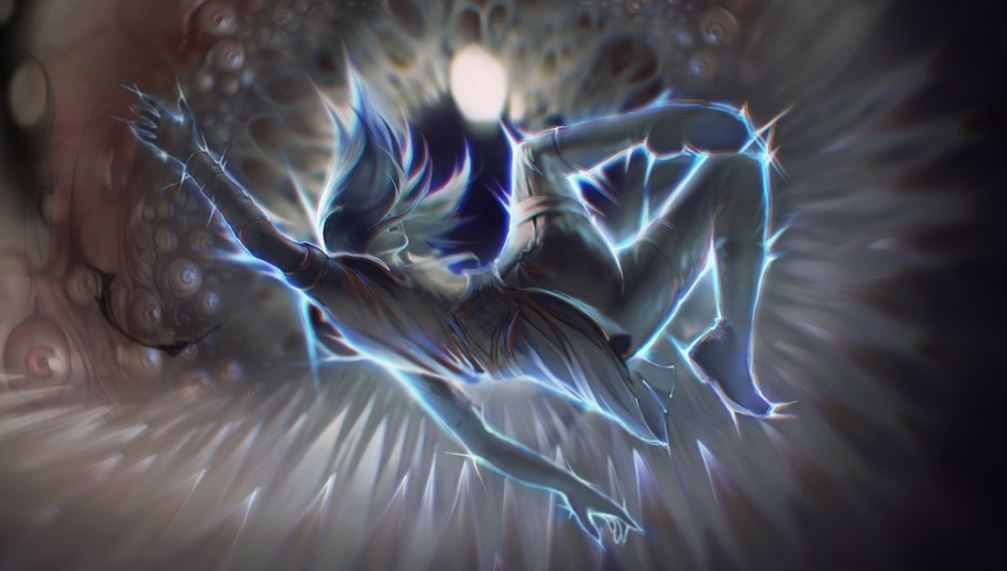
There’s a strange little quirk in Magic that never fails to amuse me: players are wildly, disproportionately afraid of being milled. You can bolt their commander, counter their wincon, wipe their board, strip their hand… and they’ll shrug it off. But flip ten cards off the top of their library and suddenly you’ve committed a personal betrayal. Milling taps into something deeper than strategy; it pokes at the psychology of loss, randomness, and the stories we tell ourselves about how our decks are “supposed” to work. And that makes it the perfect topic for a Magic Monday post.
The first factor at play is that, for many, milling feels like losing something you “should have had”. Because of this, there’s a particular kind of panic that only milling can provoke. You flip a few cards off the top of someone’s library and suddenly they’re clutching their chest like you’ve torn pages out of their favourite book. It doesn’t matter that those cards were never in their hand, never guaranteed, never promised by anything except hope and superstition. Milling feels like loss. It feels like something precious has been taken.
This is pure human wiring. We’re built to hate losing more than we enjoy gaining, and milling taps directly into that fallacy. When a player watches their favourite spell hit the graveyard, they don’t think, “Ah well, variance.” They think, “That was mine. I was supposed to draw that.” It’s an emotional reaction masquerading as strategic concern, and it’s why milling gets such an outsized response compared to almost any other form of disruption. You can Thoughtseize someone’s win condition and they’ll sigh; mill it, and they’ll remember it for weeks.


The funniest part is that milling almost never changes the odds of drawing anything. It just reveals the randomness that was already there. But players don’t experience it that way. They look at the top of their deck as if it’s a carefully curated destiny, a sequence of cards arranged by fate to deliver exactly what they needed, exactly when they needed it. Milling shatters that illusion.
When a key card gets milled, players instinctively assume it was coming next turn. They imagine the perfect topdeck that was cruelly stolen from them, even though the deck has no memory and no intention. It’s the same logic that convinces people they “would have won” if they’d just had one more draw step; comforting, dramatic, and completely detached from probability.
Meanwhile, the times milling hits nothing that excites the player? Those vanish from memory instantly. The human brain is a terrible statistician, and mill exploits that beautifully.

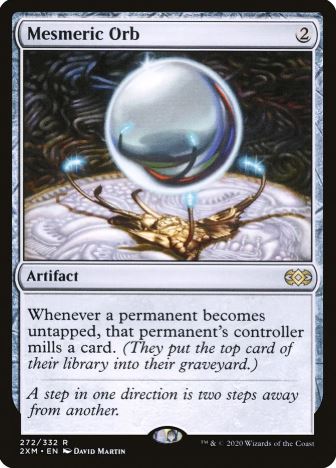
The thing is, Commander decks aren’t just piles of cards; they’re little autobiographies. Every choice – every pet card, every weird synergy, every “I know this is suboptimal, but I love it” – is part of how a player expresses themselves. So when milling starts tossing pieces of that identity into the graveyard, it feels strangely personal.
It’s not just that a key card is gone. It’s that the story the deck was meant to tell has been interrupted. Milling doesn’t just remove resources; it disrupts the narrative arc players imagine for their deck. That’s why people react so differently to discard. Discard is interactive, tactical, and almost polite in comparison. Milling is chaotic. It doesn’t ask what you’re willing to give up; it decides for you. And that loss of control, that sense of your deck being scrambled before it can perform its little theatre piece, is what makes milling feel like an attack on the deck’s very self.
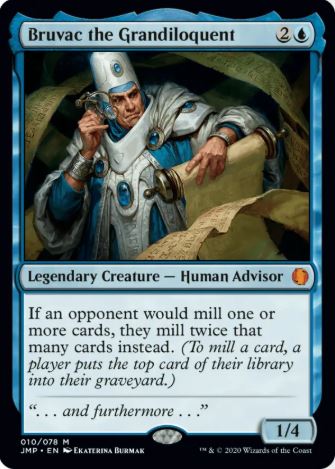
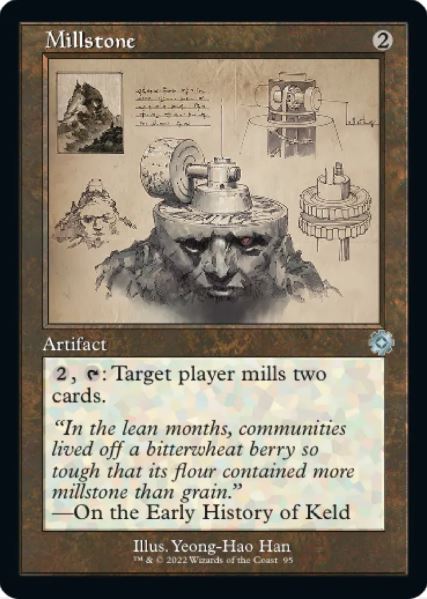
The great joke is that milling is frequently a gift. In a format where graveyards are basically second hands and most decks run some sort of recursion, milling can be the equivalent of handing someone a neatly sorted pile of resources. Reanimator decks light up when you mill them. Delve decks thank you. Muldrotha players start calculating how many hugs they owe you. Even casual decks often have enough recursion or incidental synergy that milling becomes mild acceleration rather than sabotage.
And yet the fear persists. Players will panic as their cards hit the graveyard, even while their deck quietly becomes better. Milling a deck with Scrap Trawler, Sun Titan, or any number of recursion engines is like giving them a coupon for free value. But because the emotional reaction is so strong, the strategic reality gets ignored. Milling is often less “I’m hurting you” and more “I’m pre‑sorting your resources for convenience.”

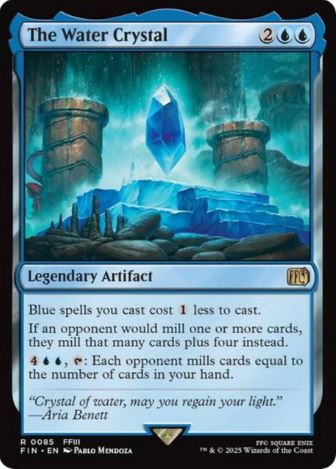
For a strategy that’s rarely lethal in a format with 100-card decks, mill attracts an astonishing amount of table-wide resentment. Part of it is that milling kills on an axis players aren’t emotionally prepared for. We’re used to losing through combat damage, or a giant spell, or some elaborate combo that at least looks impressive. Milling, by contrast, feels like being slowly erased. You don’t lose because your life total hit zero—you lose because your library quietly evaporated while you watched helplessly.
That helplessness is the real sticking point. Mill doesn’t give you the illusion of agency. You can’t block it, you can’t race it, and you can’t bluff your way out of it. It’s a countdown you don’t know the length of, and that makes people deeply uncomfortable. Even when the mill deck isn’t actually that strong, the feeling of inevitability is enough to paint a target on its back. It’s less “that deck is dangerous” and more “that deck makes me feel powerless,” and players react to that with disproportionate fury.

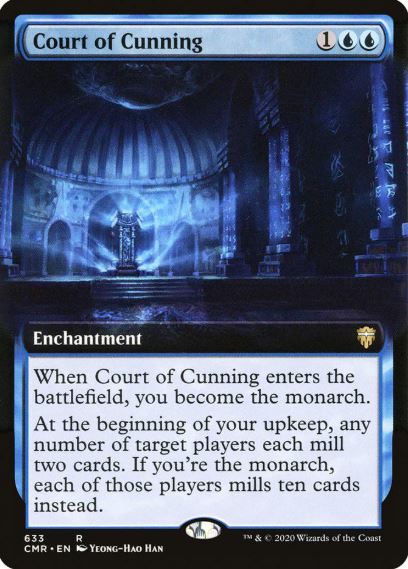
Strip away the emotion, and milling is just another form of variance. Losing cards off the top of your deck is no different from losing them to shuffling; they were never guaranteed to be drawn in the first place. Milling doesn’t magically increase the chance that your best cards are gone; it simply reveals the randomness that was already there. In most cases, the odds of drawing what you need remain exactly the same after a mill as they were before it.
And in Commander especially, the graveyard is rarely a dead zone. It’s a toolbox, a resource, a second hand waiting to be exploited. Milling doesn’t close off options; it often opens them. When you look at it through that lens, the fear of mill starts to look a little quaint; an emotional reflex left over from formats where graveyards mattered less and libraries felt more sacred.
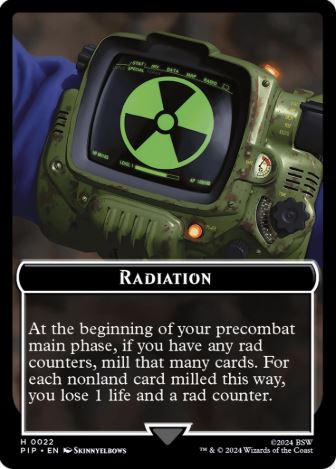
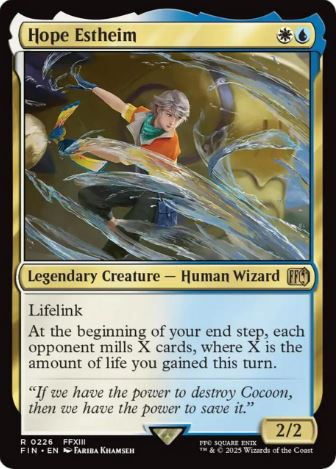
Milling has earned this strange, outsized place in Magic’s collective imagination. It’s not the strongest strategy, nor the most consistent, nor even the most disruptive, but it feels like all three. It pokes at our biases, our attachment to our decks, and our desire to believe that the top of our library holds the perfect answer, just waiting to be drawn. Milling exposes the randomness we prefer to ignore, and in doing so, it becomes the villain of stories where it barely deserves the role.
But once you step back from the emotional noise, mill is just another flavour of variance. It’s no more sinister than a bad shuffle or an unlucky draw. Sometimes it hurts, sometimes it helps, and most of the time it’s simply revealing what was always going to happen anyway. If anything, embracing mill is a reminder that Magic, and Commander in particular, is at its best when we let go of the illusion of control and enjoy the chaos for what it is.
And if you really want to ruin someone’s day, don’t bother milling them. Just counter their commander.
If you’re looking for MTG singles, please consider using our Big Orbit Cards affiliate link to find your cards whilst also supporting our site.
 No Rerolls
2 Comments