
Atomic Mass Games’ latest press release reads like a studio trying to steady itself while walking across a narrowing beam. The language is polished (“strategic focus”, “long‑term growth”, “flagship titles”) but the subtext is familiar to anyone who’s watched a miniatures studio contract before: too many product lines, not enough bandwidth, and a need to retrench around what reliably sells.
The headline move is the elevation of Legion and Crisis Protocol as the centre of gravity. That’s not surprising. Legion has just come off a second‑edition relaunch, and Crisis Protocol remains AMG’s most consistently successful line. Both have predictable release cadences, strong communities, and a clear competitive identity. They are, in corporate terms, “safe bets”.
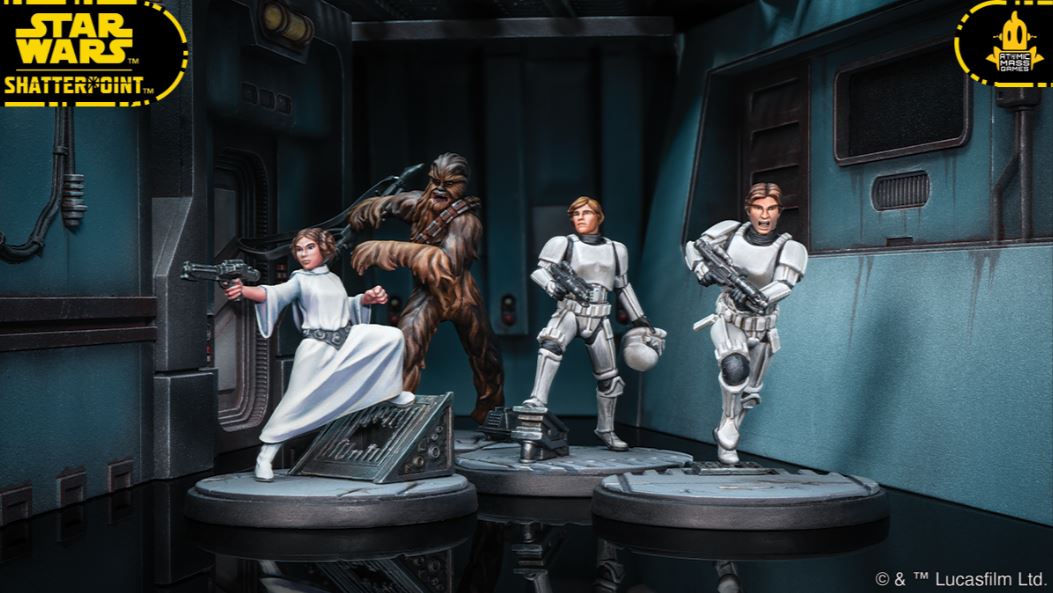
Shatterpoint’s shift to a “specialist core game line” is the clearest tell. Specialist is a polite way of saying “supported, but not actively grown”. It’s the same shelf where Games Workshop puts Blood Bowl and Necromunda: loved, viable, but not the thing the studio is betting the farm on. AMG emphasises “consistent availability” and “highest level of gameplay experience”, but the key phrase is “streamlining the number of releases”. That’s a contraction, however gently phrased.
The timing matters. AMG has spent the last few years juggling multiple Star Wars systems, a Marvel line, and the expectations that come with being Asmodee’s miniatures arm. Legion’s second edition was a major lift. Crisis Protocol is entering a phase where it needs fresh energy to avoid stagnation. Shatterpoint, meanwhile, launched strong but has struggled to maintain the same gravitational pull.
A studio of AMG’s size can’t meaningfully expand three major skirmish/wargame lines at once. Something had to give.
Let’s consider the organisational subtext. The move to co‑heads of studio is framed as a leadership refresh, but it also signals a desire for tighter internal alignment. When a press release mentions “realignment” and “organisational structure” in the same breath as product focus, it usually means teams are being reshuffled, roles consolidated, and resources reallocated. It’s not necessarily negative – sometimes it’s the only way to keep a studio healthy – but it’s rarely painless.
The quote from David Preti is unusually candid for this kind of announcement: “Realignment requires changes that can be challenging for our team and our community.” That’s as close as a corporate statement gets to acknowledging layoffs or internal upheaval.
So, what does this means for players? For Legion players, this is good news. The game is positioned as the growth engine: more expansions, more sub‑factions, more modes. Special Operations and Full Scale War are being framed as pillars rather than curiosities. Legion is being treated as a platform, not a product.
For Crisis Protocol players, the message is stability and renewed cadence. The Marvel universe is bottomless; the challenge is pacing and consistency, and AMG seems to know it.
For Shatterpoint players, the message is mixed. The game isn’t being abandoned, but it’s being moved out of the spotlight. Releases will slow. The meta will stabilise; perhaps too much. The community will need to carry more of the momentum.
There are implications for the broader ecosystem. The final paragraphs gesture toward “new market opportunities” and “innovative distribution models”. That’s vague, but it hints at two possibilities:
- Experiments with direct‑to‑consumer releases
- more crowdfunding‑adjacent strategies, given Preti’s title
Both are becoming standard in the industry. Both can be healthy or exploitative depending on execution.
However, strip away the corporate varnish and the story is simple: AMG is consolidating. Not collapsing, not flailing; consolidating. Betting on the lines that have proven their longevity. Protecting the ones that can’t sustain a full release treadmill. Trying to build a studio that can actually keep pace with its ambitions.
It’s a familiar cycle in miniatures gaming, but the tone of the announcement suggests AMG wants to manage this contraction with more transparency than most. Whether that holds will depend on what the next six months look like: release cadence, communication, and how Shatterpoint’s “specialist” status plays out in practice.
 No Rerolls
It’ll be interesting to see how this shakes out – cheaper (re)packs with more models (aka MCP repacks) or items going out of stock and not coming back – especially if they’re less popular…
LikeLike