

Another week, another interesting dice-based Kickstarter, eh? Following on from last week’s D120, the FlipDie is a very different concept with a very different aesthetic. Gone are the clean, machined lines of the D120, and here comes the ornate designs on these fantasy-themed die/coin hybrids:

Okay, so, let’s just say right away that these are very pretty. In the context of our hobby, they’re also not hugely surprising. Well, the surprise might be that I’d not really seen something similar before. There’s been a trend for some time of big Kickstarter games selling metal coins as either a stretch goal or an option (read: paid) extra. This is completely understandable, as there’s just something satisfying about metal coins. Maybe it’s the feed of them; the cold weight, or the clink as they collide. Stonemaier Games’ hit board game, Scythe, has a metal coin upgrade pack that really exemplifies what I’m talking about:
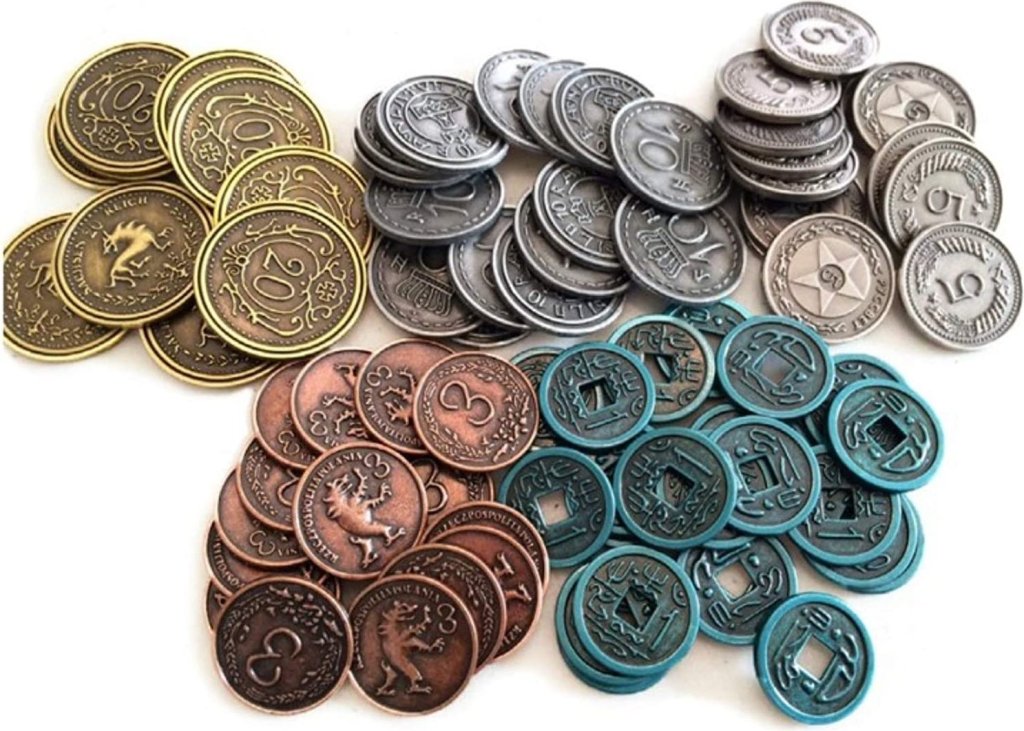
These are reasonably intricate designs that are also nicely weathered. It’s a good set. I don’t own them myself, but I’ve played with them and there’s no denying that they do add to the experience of the game. I found myself often fidgeting with them between turns.
So, as a group with a shared hobby, we like metal coins. But how do they work as dice? Surely you just flip a coin to arrive at a binary outcome. It’s heads or tails, isn’t it? 0 or 1?
Not necessarily.
Here’s what a FlipDie looks like on the inside:
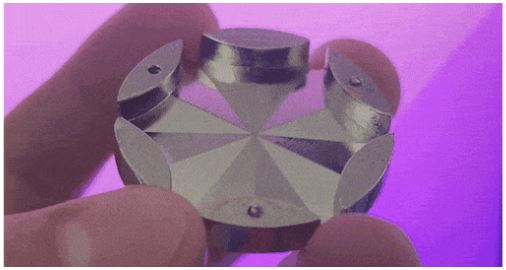
The coins are pretty thick. Inside, they are hollow. Depending on the type of dice, there are a number of gaps around the edge. Inside the coin is a small, coloured ball. This ball will be slightly larger than the gaps. When the coin is flipped, the ball will dislodge and be sent to a random edge, sitting in the gap the will correspond to a specific number on the face of the coin. It’s essentially a shaker, rather than a die. The ball being a colour that contrasts with the metal of the coin is also very important, making it easy to spot at a glance and ensuring that you can read the die pretty quickly.
Make sense, doesn’t it? It’s a cool concept and actually pretty simple.
Is it fair, though? Pre-empting the question, the project creators have included the following graph, showing their results to be broadly on par with dice from other manufacturers:

Now, this next bit is where I reveal myself to be an idiot…
Here’s a picture of a D8 next to the equivalent FlipDie. Let’s agree that this design is gorgeous. The thing is, I see a 1, a 3, a 4, and an 8. How is this going to replicate an 8-sided die?

I spent quite a while sitting staring at this picture pondering that very question. Then it hit me. And then I felt stupid. It’s a coin. You flip it. The remaining results are on the back. Duh. Yeah, ok, this makes sense, and I am the worst.
Let’s move on.
Swiftly.
Each set of dice has the same designs, though there are some options as to the finish used on the coins. I like that you get a choice in this, as the sets are quite different:
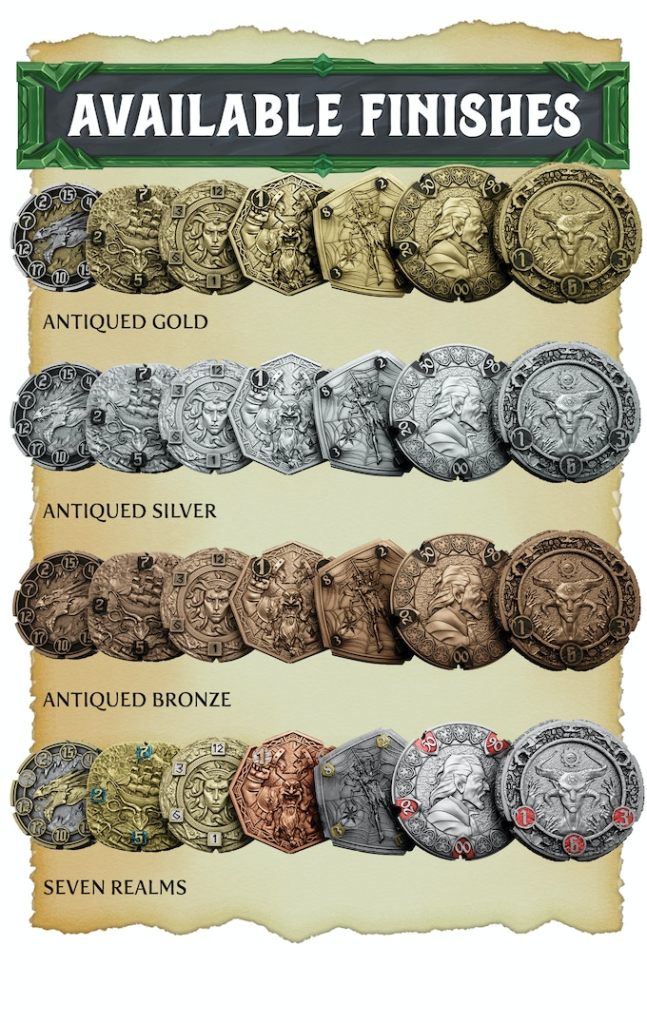
My favourite is the Seven Realms set. This is my favourite by far. All of the sets look great, and I’d happily take any of them, but I love the variety in the Seven Realms set and I really like the coloured accents on them.
Stepping back and looking at the project, we need to now ask… are they worth the price? Well, I think these “dice” tick a lot of boxes:
- They look great
- It’s a neat idea
- they will feel satisfying to use
- Very characterful for some games
Obviously, these are purely for RPGs. I’m not going to grab a few dozen of their D6 variant to play Warhammer. That would be terrible. They’re also clearly built for games that use a polyhedral set like that popularised by Dungeons & Dragons. That’s fine, of course. You just need to know what you’re getting.

On price, a single coin will cost you $25. No. We’re not doing that. A set of all 7 of the dice you would need to replace a polyhedral set will cost you $99 at the early bird price, or $119 thereafter. This will also include a mat, a box, and some stretch goals. This is far more reasonable than the price of an individual coin, but is still a decent chunk of change. Additional savings can be had with multiple sets.
The cost of this set is comparable to the price of one D120 from last week’s Kickstarter-Watch. They’re also a lot more usable than that item. They’re probably too expensive for me to justify, but they are a boutique item. You’re buying a unique, ornamental item. I’ve certainly spent more on a single miniature. If you have the money for it, and this is your hobby priority… go for it! This is a really fantastic project.
 No Rerolls
2 Comments