

The least prestigious award in tabletop gaming returns after a 2 year, pandemic-related hiatus! Woo and/or yay!
Welcome to our top 50 games list for 2022, in which I list my personal top 50 games at this point in time. My choices are not limited to games from this calendar year, but instead, represent my current thoughts on the top 50 games to me. Next year, some of the games featured may move up and down as my opinions change and I get the chance to play more games or revisit old favourites.
This series will comprise 5 posts, each covering 10 games as we work down from number 50 to number 1. Following on from part 1, part 2, and part 3, let’s dive into our penultimate post, eh?
20: Paperback

Previous Position: 36 (+16)
Year: 2014
Designer: Tim Fowers
Publisher: Self-Published
Plays: 2-5 players in ~45 minutes
Liking both word games and deck builders, Paperback – the marriage of the two – was a no-brainer for me. As in other deck builders, you are working to build an engine with your deck, but in Paperback you are not just trying to play a series of optimal cards to give you currency to buy effective action cards and valuable points cards. I mean, you are doing this, but your cards are also letters and combinations of letters that should spell out words.
I like the form factor of this game, being the same size as a deck builder toolkit for Magic and yet fitting in a deep, fun experience. The visual design is clear and simple. There’s no art on most of the cards, except for the points cards, which are imagined as book covers from various genres. This lack of visual generosity would bug me in another deck builder, but it works here, with each card only representing a letter or group of letters. It actually helps maintain clarity.
This has been a pretty consistent favourite for me, but not one I’d play with every group.
19: Mutant: Year Zero

Previous Position: New to the List
Year: 2014
Designer: Tomas Härenstam, Petter Bengtsson, Chris Birch, Anders Blixt, Thomas Johansson, Nils Karlén, Kosta Kostulas, Chris Lites
Publisher: Free League
Plays: I dunno, how big is your table? in hours to years, pal
Any book by Free League is a work of art. Mutant: Year Zero is no exception. The game itself is also really good. The underlying system that Free League designed is absolutely solid, and is a fantastic example of a nice, modern dice-pool system. It’s now been rolled out to other games like Alien, Blade Runner, Coriolis, and others.
I’ve had a lot of fun with this game over the past couple of years. My favourite bit is actually not the core system, but rather the base-building aspect, which I’ve written about previously. I really want to run another game of this, as the last one kind of drifted apart as lockdown ended.
18: Scythe
Previous Position: 15 (-3)
Year: 2016
Designer: Jamey Stegmaier
Publisher: Stonemaier Games
Plays: 1-5 players for ~90 to 115 minutes
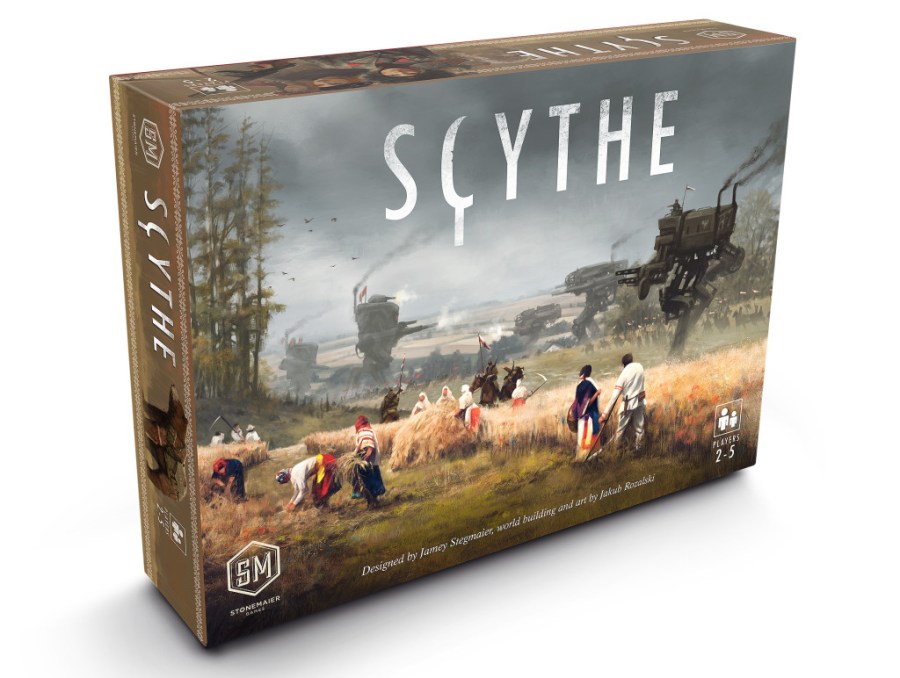
Scythe is a genuinely fantastic game. Opening the box, you see your plastic character and mech miniatures and you might assume that Scythe is a war game. It’s not. It’s really, really not. It’s very much a resource management game. It’s also downright beautiful, both in terms of the design of the pieces and the artwork used. The board, in particular, is a thing of beauty. This also works really well on Tabletop Simulator, if you’re that way inclined.
I’m still playing a fair bit of Scythe and loving it every time. I’m at the point where I want to start mixing in some of the expansions and I hope they’ll add some fun extras to the game. It’s fallen down the list a little bit, but that’s because it’s shifted from being ‘the hotness’ to instead filling the role of a comfortable friend.
17: New York Zoo

Previous Position: New to the List
Year: 2020
Designer: Uwe Rosenberg
Publisher: Feuerland Spiele
Plays: 1-5 players in ~30 to 60 minutes
Uwe Rosenberg likes to publish these tile-laying games. They’re usually pretty good, too. One of his previous tile-laying games, Patchwork, was number 48 on my list back in 2018. It fell off the list in 2019 and now New York Zoo has made it onto this year’s list. This is way better than Patchwork. I really love it. I didn’t think I would when I first played it; it just didn’t look like my sort of thing. I am delighted to have been proven wrong.
The game is fun, cute, and can get pretty competitive. In my last game, late-on in the session, there were three of us all going for the same tile and, sure enough, the one who managed to nab it ended up claiming victory. Fantastic!
16: 1960: The Making of the President
Previous Position: 8 (-8)
Year: 2007
Designers: Christian Leonhard, Jason Matthews
Publisher: GMT Games
Plays: 2 players in ~90 minutes
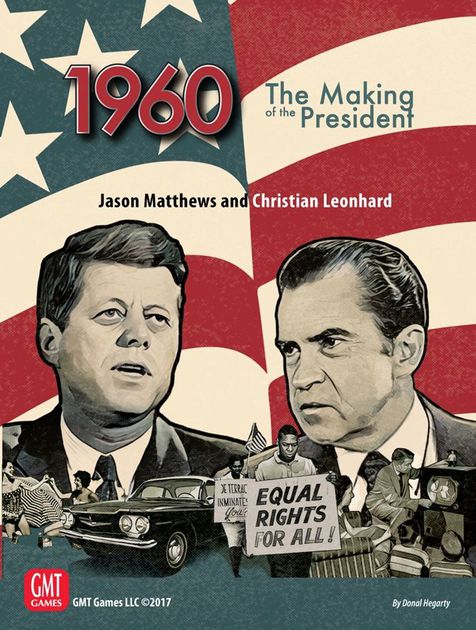
When I first got the game, after only playing it once or twice, I just saw it as a lighter, simpler Twilight Struggle. I questioned why, with most people, I would choose this over TS. Since then, I’ve played it a lot more and, although I still prefer Twilight Struggle, I see the value of 1960 far more clearly than I did. It has players taking on the roles of the Kennedy and Nixon campaigns in the 1960 US presidential election. It’s actually quite unique and offers a different experience to Twilight Struggle. It is a little lighter, but it’s interesting in a very different way.
I love the back-and-forth of the game. The idea of taking the candidates and zipping them here and there across the US is a lot of fun. As with Twilight Struggle and Washington’s War, I really like the card-driven nature of the game. I’m a lot better with Nixon than with Kennedy in this game. Tricky Dick’s had my back.
15: Eldritch Horror
Previous Position: 17 (+2)
Year: 2013
Designer: Corey Konieczka, Nikki Valens
Publisher: Fantasy Flight Games
Plays: 1-8 players in ~120 to 240 minutes
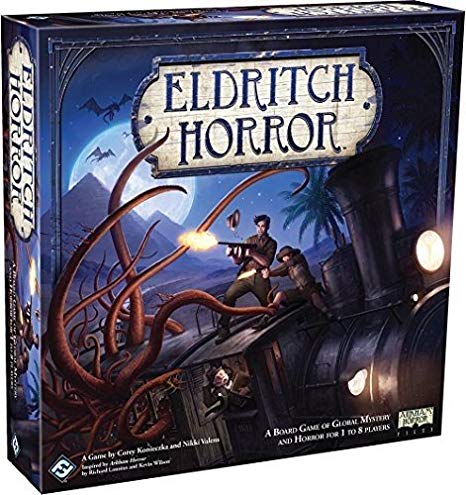
Eldritch Horror is an expansive game of cooperative awesomeness. Players work together to defeat an evil threat to the world. This is often, for me and my group, an exercise in utter, doomed futility, but that’s ok. I love how this works. I love that there are a lot of moving parts going on. I love how characters develop as the game goes on.
I particularly like playing this when there’s no time pressure and with a group that will really get into the spirit of the game. Just reading the mechanical implications of the cards does work, and it’s probably the fastest way to play. I prefer properly reading each card as, adding up all of the horrific events that these characters go through, you end up with quite a story developing in each game. Eldritch Horror is fun and it is difficult, and I love it.
14: Dead of Winter

Previous Position: 21 (+7)
Year: 2014
Designer: Jonathan Gilmour, Isaac Vega
Publisher: Plaid Hat Games
Plays: 2-5 players in ~45 to 210 minutes
Dead of Winter is a great semi-cooperative game where players work together to meet a shared objective whilst also trying to fulfil an individual, secret objective. The Crossroads cards, for which this series of games is named, is an event deck that triggers each turn if and when specific pre-requisites are met. The Crossroad cards take a game that would already be great and add a random element that really works well to up the ante and create truly tense situations. Some of the cards really screw you over, too!
I love working with others and planning out how to meet the shared objective in this game. I do try to meet my shared objective, but I always try to keep a handle on the shared one. Maybe this is why I lose so often… Dead of Winter is tense, fun, and occasionally manic. It can present truly difficult decisions, but also hilarious situations. This is a game that really develops a narrative in a natural, unforced way.
13: New Angeles

Previous Position: 10 (-3)
Year: 2016
Designer: James Kniffen
Publisher: Fantasy Flight Games
Plays: 4-6 players in ~120 to 240 minutes
I really like the Android setting. The body of artwork that Fantasy Flight amassed for their work on the now-discontinued Android: Netrunner is simply stunning and, I hope, will see significant reuse in future games in this setting. The Android setting book for the Genesys RPG is also pretty fantastic.
New Angeles is all about negotiation and I love it. Players each take the role of one of the major corporations (or a federalist infiltrator looking to sabotage the game) as they work together to meet the needs of the city and jockey for influence within it. They bid to be the player to launch specific projects aimed at optimising or adjusting the production in the city or just for personal gain. I love the interactions, negotiations, and backstabbing that the game fosters.
12: Among the Stars

Previous Position: 12 (unchanged)
Year: 2012
Designer: Vangelis Bagiartakis
Publisher: Artipia Games
Plays: 2-4 players for ~30 minutes
A really great drafting game, Among the Stars sees each player building a space station with their drafted tiles. These stations are all about synergy, with different tiles interacting with one another in order to generate points. it sounds pretty simple, and it is. The drafting stage is an absolute joy, as you rummage through your options, working out what works best with what you’ve already got and considering your options for the future of your station.
Visually, this game is an absolute treat, with each room being lovingly depicted in fantastic, original artwork. I’ve played this game a lot and I’m still playing around with different synergies and options. I never feel like I’m just trying to recreate the same bases over and over, but rather adapting to a fresh design each time.
11: Traveller (Mongoose 2nd Edition)

Previous Position: 16 (+5)
Year: 2016
Designer: Shawn Driscoll, Dale C. McCoy, Jr., Marc W. Miller, Gareth Ryder-Hanrahan, Matthew Sprange
Publisher: Mongoose Publishing
Plays: I dunno, several (?) players in ~Yeah, this doesn’t work for RPGs minutes
This is one of the RPGs that I make more of an effort to collect. Partly because I really like the system and the production values of the books, and partly because the release schedule is quite forgiving. Mongoose isn’t flooding the market with a ton of crap for Traveller, so I’m able to keep up pretty easily, especially when I’m not collecting adventures. That said, with the resurgence of miniatures in my life, my RPG collecting has fallen somewhat by the wayside.
Traveller definitely has one of the most interesting character creation processes that I’ve ever seen. I like that at the end of the whole thing you’ve got not only a sheet of stats and skills, but also a detailed backstory. It can throw up a few oddities, of course. I once rolled up a naval officer who had managed to lose a few limbs in his career and had spent a long time in prison. Good times!
I also had a really fun game of Traveller at Tabletop Scotland in 2019. Good GM, lovely group. Have run it a couple times since, as well.
 No Rerolls
Woo! Glad to see 1960 on the list. Though a drop from 8 to 16 is only -8, not -16 🙂
LikeLike
Ty. Will fix. Its a great game.
LikeLiked by 1 person
Going have to take a look at Mutant Year Zero. We tried New York Zoo, being a fan of most of Rosenburg’s
games. But for whatever reason it just didn’t click with us like I was hoping.
LikeLike