
I’m far from alone in really rating Stonemaier Games. They are a company that has really managed to leverage good game design, a fantastic aesthetic, and savvy marketing (including a mastery of Kickstarter as a platform) to quickly grow from a startup to one of the most respected studios currently producing board games.

Viticulture was their first big hit, and Scythe cemented their place of prominence in the industry, but Euphoria was an overlooked gem. Like last month’s Lords of Waterdeep, Euphoria is a worker placement game, cand one which I really enjoy. I’d gotten in a few games of it back before lockdown, but managed to get it back to the table this month.
Let’s take a look at why I love it, shall we?

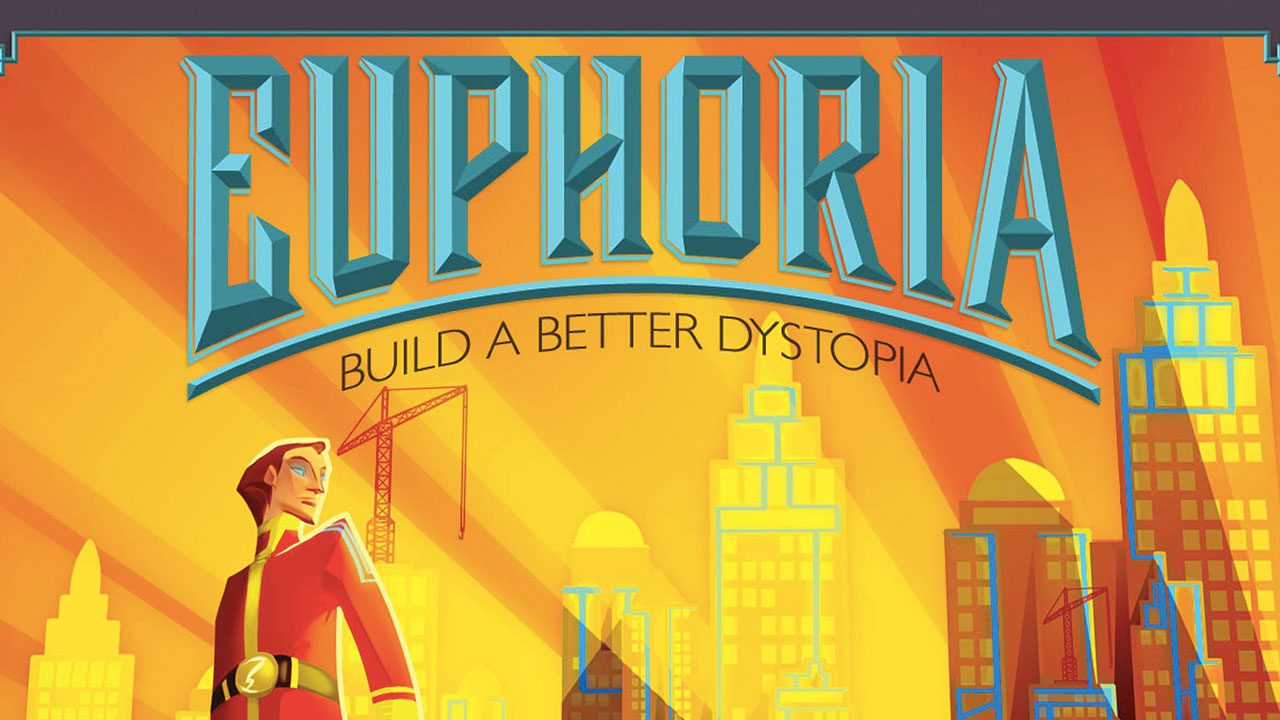
A big strength of many of Stonemaier’s games is their design and production quality. Euphoria comes with a double-sided game board depicting the city of Euphoria and its underground tunnels. The board is beautifully illustrated with intricate details, capturing the dystopian theme and enhancing the immersion. The components include custom-designed dice, wooden tokens, and cards with evocative artwork that adds to the game’s atmosphere. The overall production quality is top-notch, creating a visually appealing and tactile experience.
Factions and Gameplay: Euphoria features different factions, each with its unique abilities, goals, and starting resources. These factions add variability and replayability to the game as players explore different strategies and combinations. The gameplay revolves around worker placement, where players assign their workers to various locations on the board to gain resources, recruit citizens, construct markets, or trigger special abilities.

The workers in Euphoria are represented by dice. Each worker has a value ranging from 1 to 6, representing their knowledge level. Higher knowledge levels provide access to more resources but also carry risks. Players must decide whether to use workers with higher knowledge, which might trigger negative consequences (the loss of a worker) if their combined knowledge reaches a certain threshold, or to keep their workers ignorant but limit their potential actions.
To achieve victory, players must strive to complete their faction’s objectives, construct markets, and earn influence. The game offers different paths to victory, letting players focus on building, resource gathering, or other metrics. There’s not a huge amount of direct interaction between players, except in the collaborative building mechanism, which is the main form of direct interaction.
The game is mostly symmetrical at its core, with differentiation coming from factions and recruit cards. Recruits give variable player powers and unlock faction bonuses. They make for more interesting play and give more replayability.
While the rulebook is well-written and comprehensive, Euphoria does have a moderate learning curve, and we did find it a little hard to answer a couple of specific rules questions. Understanding the synergies between different actions, managing workers’ knowledge, and optimizing resource allocation might take a few playthroughs to grasp fully. However, the game’s mechanics are intuitive once you become familiar with them, and the strategic depth and rewarding gameplay make the learning process worthwhile. Returning to the game after a long absence, we found the first few turns to be quite slow, but things quickly picked up as we got into it.
The recruit/faction dynamics, the solid worker placement mechanics, and the quite tight resource management elements of Euphoria provide engaging decision-making opportunities, while the variability keeps the game fresh and exciting. It is a game that rewards strategic planning and adaptability, making it a great choice for enthusiasts of euro-style games. This is a solid recommendation and a worthy game of the month for June!
 No Rerolls
12 Comments