
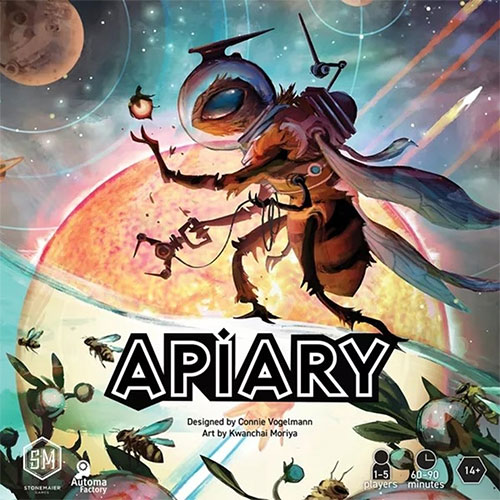
This month’s Game of the Month is Apiary, a worker placement board game about space bees that are in space.
End of review.
5 stars.
What? Fine!
Designed by Connie Vogelmann and published by Stonemaier Games (of Scythe fame), Apiary was an instant hit with my group and it’s been my most played game of March, by far. We’re just really loving it.
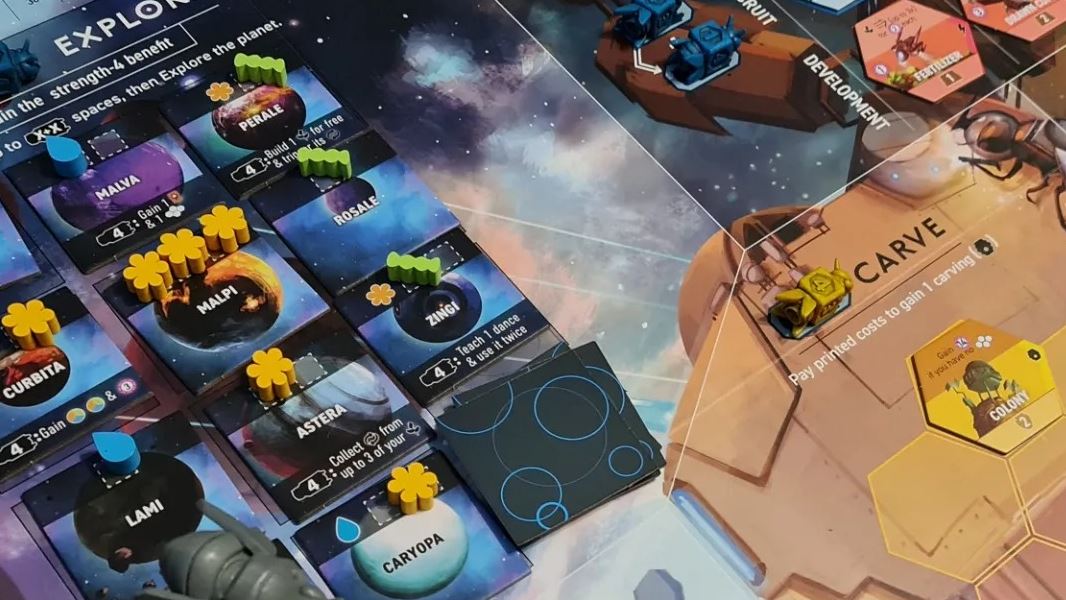
The heart of Apiary is a simple worker placement game. You place a worker and resolve an effect. Simple. Typical, even. This becomes a bit more interesting when you factor in how your workers level up. Stonemaier have published workers placement games with varying worker qualities before. Euphoria, for example, had you roll a dice which would then represent and set a value for that worker. In this case, the worker is placed on the board at a set level, with most workers starting at level one (of four). When that worker is then removed from the board, either by choice or by being bumped off a space, it returns to you, gaining a level. The level of a worker has a pretty big impact, giving you more purchasing options when adding to your hive, more actions to take, more distance that can be covered when exploring, and so on. When a worker reaches level 4, it can then trigger lots of cool stuff, including adding new win conditions, upgrading your faction bonus, letting you define new actions that players can take, unlocking the highest-scoring tiles, and more. They’re great! The thing is, once they’re used, that’s them done. When they would return to your hive they cannot level up again and instead enter hibernation. They return to level 1 and a hibernation token is placed in the hibernation cone. These unlock one-time bonuses and act as a time for the game, as the game ends once these hibernation spaces are completely filled, much like the building spaces in Architects of the West Kingdom. I’ve found that game length can vary considerably, depending in how aggressive or conservative players are with their bees, and how they manage their levelling and hibernation cycles.
Your main, individual player board is your ship. There are several to choose from, each having a different layout and different bonuses attached. My favourite ship is the one that gives construction discounts. This is really handy early on. Others give points for building, or resources, or helps to manage your workers. You get a nice chunk of points at the end if you manage to fill your original ship. I say original because you can expand your ship. You can expand it quite substantially, actually. You do this by buying (or otherwise acquiring) frames. Frames have 4 spaces that you can fill and are added to the edges of your existing ship. You get points for each full frame at the end of the game, too.
The spaces on your ships are filled with four types of tiles; farms, recruits, developments, and carvings. Farms are for storing resources. Recruits provide lasting effects, usually modifying one the actions that your workers can take. Developments give one-off bonuses. Carvings are higher-scoring tiles, the points for which are calculated at the end of the game. A couple of good recruits and a carving can often direct the course of your game by making certain actions more attractive, or encouraging you to build in a certain way.
For those counting, we’ve got a few different push and pull factors for your playstyle now. We’ve got the ship you get, lasting effects from workers, and points from carvings. The other two major factors that determine direction are planted seed cards and your faction bonus. Your faction bonus usually either gives you and extra action, a bonus to an action, or an additional method of end-game scoring. For example, you might be able to swap resources, or you might get points for each farm tile you build adjacent to your faction tile. The cards in this game have three uses. They can be scrapped for a basic resource, used for the ability at the top of the card (these range from quite good to truly excellent, though are often quite situational), or ‘planted’ as seeds on your ship to give you extra ways to score points. Examples may include points for each farm built, each frame built, maintaining a certain amount of favour with the queen, and so on. I’ve seen people win without using seed cards, but I’ve only won in games where I’ve used them well.
I really enjoy this game. I like that, although resource management is a massive part of the game, it doesn’t feel cumbersome. Resources are reasonably easy to get, and can be plentiful, though you my be limited, especially early-on, by your storage capacity; a problem which can be overcome by building more farms. I like the feeling when your get a nice, long turn due to good combinations of cards and actions. Those feel like proper big-brain moments. I like the fact that I have turns where I plop a worker down with little thought because there’s so much that I can do and nothing seems wrong, but also turns which are a little oppressive and you’re overthinking your own moves, and whether someone can buy that great tile before you get to it, and if I do that action it would push an opponent’s level 3 worker off the space and give him a level 4 workers and what could he do with that… There’s a lot here, but you only really feel that in short bursts.
The game isn’t perfect, and one of my favourite aspects is also one of the areas of mild concern. There’s an asymmetry here, which I love in game (like, really), but the factions can feel a bit uneven in places. This is also not a game with a lot of player interaction. There’s competition for tiles and resources, and there are some cards that introduce a drafting element, but that’s about it. The game is largely about efficient management of your hive. With no player interaction or conflict, there’s no route for self-correction of imbalance. If a more conflict-heavy game sees a player running away with it, there’s the opportunity for other players to act and cut the leader down to size. here, there’s nothing to do but watch the situation snowball. And, you know, I’m not even saying that there should be conflict. Not all games should be wargames. It’s just a slight niggle that’s really starting to show itself as we get more games under our collective belts.
Apiary is going to appear in this year’s top 50. I’d be surprised if it didn’t get into the top 20, at least. I’m absolutely loving it. I’ve played it with several different player counts and consistently enjoyed it. I’ve not played the solo mode (that’s not really for me), though I’m told it’s very good. The game initially feels quite intimidating, but everyone I’ve played it with seems to pick it up quite quickly after a couple of turns. I can see this continuing to make it regularly to the table for a long time to come.
 No Rerolls
17 Comments