
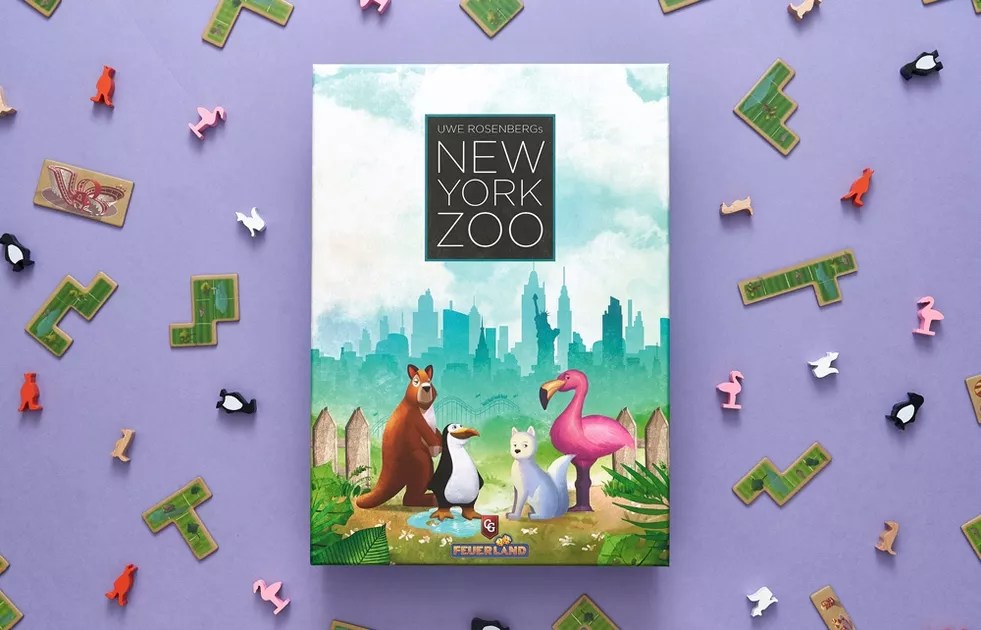
In New York Zoo, players step into the roles of zoo developers, tasked with constructing animal parks and filling them with a variety of animals and attractions. The game was designed by veteran designer Uwe Rosenburg and published by Feuerland Spiele in 2020. I purchased this game myself in 2022; no review copy was provided. There are affiliate links at the end of this review.

New York Zoo combines tile placement, puzzle mechanics, and strategic decision-making. Let’s break down how the game works. Each player is given an individual player board split into squares, on which we will build the enclosures that will comprise our zoo. In the middle of the table, there’s a large track around which players travel, picking up polyomino tiles to represent enclosures and animal tokens to populate said enclosures.
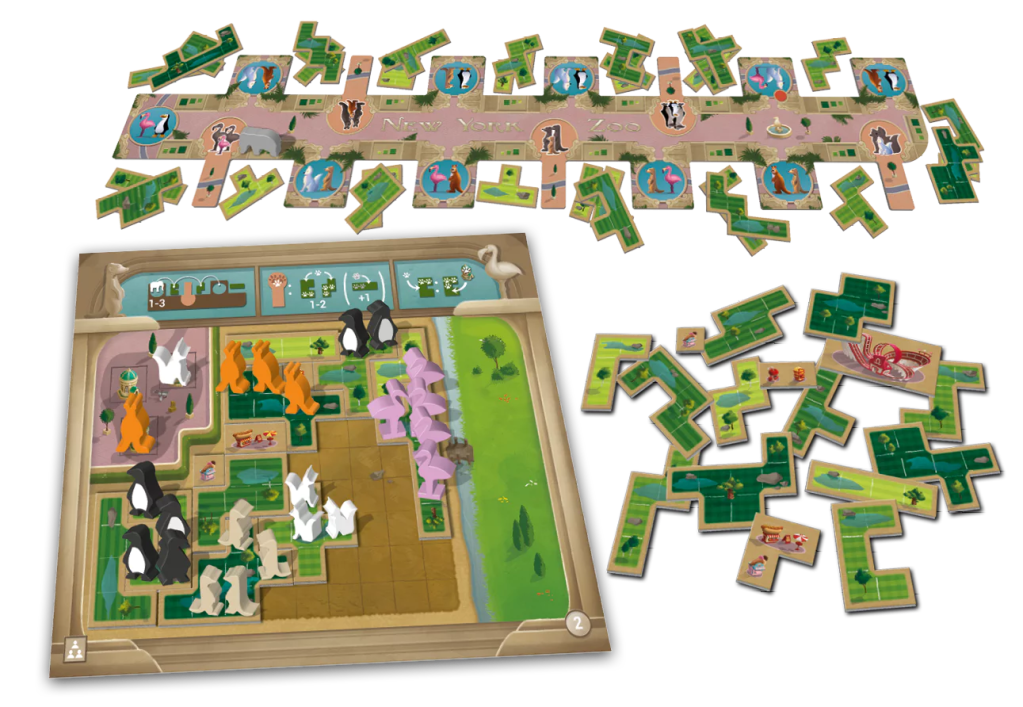
On their respective turns, players choose between two options; picking up tiles or picking up animals. As mentioned, these irregularly shaped tiles represent enclosures. The first player to completely fill their player board wins the game. Enclosures, therefore, as really important. They come in four colours and get progressively darker by the number of squares that they cover, going from just 4 squares at their lightest, to 7 at their darkest.
Animals are represented by delightful wooden meeples. They come in the form of penguins, flamingos, meercats, arctic foxes, and kangaroos. Yes, it does feel quite random. Each animal space that you can land on gives you a pair of different animals to add to your zoo. You’ll be looking to group animals of the same type in the same enclosures, with a particular focus on getting an initial batch of 2. This is important.
It is important because when you have two animals, they can then breed. This gives you a second source of animals, beyond just the animal spaces on the track. Animals breed whenever that animal’s breeding space is crossed on the track, with one player triggering, uh… the event for all players. They produce offspring, which are added to existing enclosures. When an enclosure becomes full, animals are removed, and players can add attraction tiles to their boards.
Attraction tiles represent various features like food stands, restrooms, or playgrounds. They have more regular shapes to them than the enclosure tiles do, and the smaller ones are crucial in filling the gaps left by enclosure placements. Realistically, you’re not going to complete your board without at least a few of these tiles.
New York Zoo strikes a really good balance between accessibility and depth. It’s suitable for families and more experienced gamers alike. Having played it at club, I actually picked it up on a caravan holiday to play with my in-laws. It was a total success and I’ve played it a lot with them, since. It also still sees semi-regular play at club, particularly among the board board gamey crowd.
The theme of building a zoo in the heart of New York City is engaging and unique. Well, it was until Ark Nova came along, but this is a lot lighter and quicker than Ark Nova! The breeding mechanics add strategic depth to what is otherwise a straightforward tile-laying game, and players must plan ahead to maximise their animal population.
The game’s pacing is excellent, playing in 30-60 minutes. The puzzle aspect keeps players engaged, as they optimise their zoo layout. Components, including the adorable animal tokens, are really nice, further enhancing the overall experience.
New York Zoo invites players to create their own peaceful garden of animal enclosures, blending strategy and enjoyment. Whether you’re a puzzle enthusiast, prolific board gamer, or just looking for a light game for the family, New York Zoo is a solid choice.
 No Rerolls
You sold me! This one looks like a ton of fun.
LikeLike