
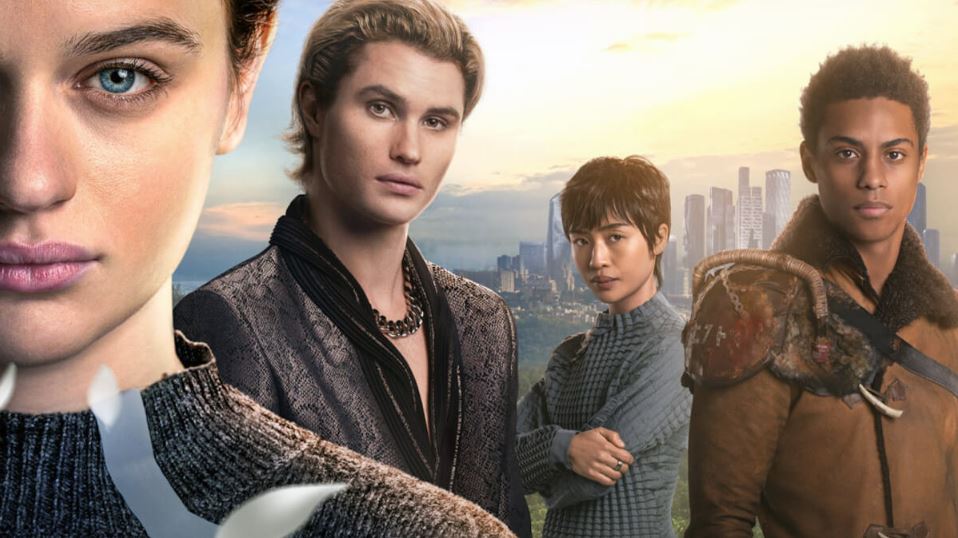
Uglies is a 2024 dystopian drama directed by McG, based on Scott Westerfeld’s popular YA novel. This review is intended to be free of spoilers, but none of us are perfect. No review copy was provided.
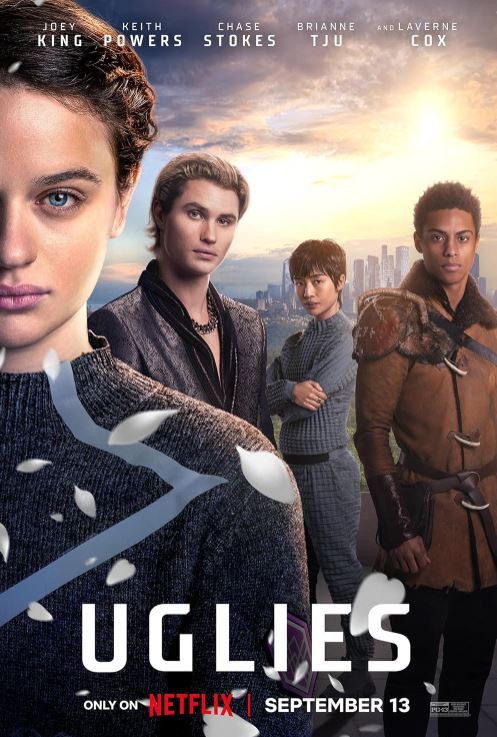
Uglies is one of many, many, many dystopian young adult stories. The Hunger Games really changed the YA genre, flooding it with bleak futures and valiant youths who set out to change their broken societies. It’s funny that this came to my attention when it did, as I am currently teaching a unit on dystopian fiction, so I’m somewhat immersed in the genre at the moment.
The film is set in a future where society has eradicated divisions of class, race, and nationality through a universal standard of beauty. On their 16th birthday, everyone undergoes a procedure to become “pretty,” leaving those under 16, the “uglies,” to live in drab, gray compounds. The pretties live in a vibrant city that seems to be an endless carnival of delights. So far, so formulaic.
The story follows Tally (Joey King), who eagerly awaits her transformation. However, when her best friend Peris (Chase Stokes) becomes pretty and cuts off contact, Tally’s excitement turns to doubt. She befriends Shay (Brianne Tju), who plans to escape the procedure and live authentically with a group of outlaws known as “The Smoke,” led by David (Keith Powers). Tally’s journey to find Shay and bring her back, under the coercion of the authoritarian Dr. Cable (Laverne Cox), leads her to question the very foundations of her society.
Hilariously, the whole act of going out to the woods and finding truth made me wonder if we were getting some Henry David Thoreau by stealth. You know the old chestnut:
“I went to the woods because I wished to live deliberately, to front only the essential facts of life, and see if I could not learn what it had to teach.”
But, nah. We don’t.
There are some good elements at work here. I’ve not watched Joey King in anything since she was a child actress in The Dark Knight Rises. She’s good. Her performance is good. She’s likeable and compelling; able to capture the character’s internal conflict and growth.
Laverne Cox is also good, and I want to talk a little about this casting choice. Laverne Cox is a trans woman and I love that she was cast as the villain. First of all, it’s great to see trans actors and actresses in movies at all, and especially in roles that are not explicitly “trans roles”. Allowing trans folks to play complex characters, including villains, shows the range and talent of the individual performer and helps to break the mold of typecasting. I like the she was cast in a powerful role; not something that seems common for trans performers. I love most of all that she gets to be a villain. Cox is able to bring a fantastic theatricality to the role. The producers were also willing to portray a trans person as an oppressive, malevolent, evil person. Now, I am not saying that trans people are necessarily those things; I’m saying that people can be those things. But not being afraid to cast trans performers as shitty people, this further normalises the casting of trans actresses and actors in more varied roles that are not defined solely by their “transness”. I might have gone on a bit of a detour there, so let’s return to the most important point; Laverne Cox plays a fantastic villain who consistently steals the scene whenever she shows up.
The film also looks great. It’s an absolute visual treat with some decent CGI and cool sets. It also does a good job of contrasting the utopian city of the pretties and the stark world of the uglies, whilst not resorting to making the latter ridiculously bleak or unlivable.
The themes the movie explores are also worthy ones. Beauty standards should be re-examined. The thing is… the are. Lots of media tackles this topic, and not always as ham-fistedly as this does. The social conformity theme is also one that is dealt with in many YA novels and films. I feel that’s represented reasonably well here.
There are some pretty glaring weaknesses in this film. You’ll know from many of my book reviews that pacing matters to me a lot. This is a film that is full of fits and starts. The narrative struggles to maintain momentum, with action scenes falling flat and lacking the sort of tension that would make them more compelling.
The script often feels clunky. It’s just too heavy on exposition. Too much of the worldbuilding is done via telling, rather than showing. Where we do show rather than tell, including in introducing important technology that will come back later in the film, it feels a bit ham-fisted. Stuffing the dialogue full of exposition just detracts from the emotional weight of the story. It’s clumsy.
This all detracts from the worldbuilding; something I really love in a lot of books and movies. The film’s depiction of its futuristic setting feels somewhat superficial. It feels gimmicky in places; cursory in others. Technology is incredibly conveniently placed and it suffers from the common YA trope of just waving one’s hand at a problem and solving it via “hacking”. How is this hacking done? Dunno. Do our heroes ever seem to actually demonstrate these skills in any understandable way? Nope.
Look, the film has its moments, but it ultimately falls short of its potential. The film’s message is about the dangers of a homogenised society, but then most YA fiction tends to be. The execution leaves a lot to be desired. Fans of the book might appreciate seeing the story come to life, but fans of the genre might find this a lacklustre offering.
Is it worth a watch? Maybe. If you’re a fan of YA dystopian dramas, it has some unique elements and several really good performances. As a package, it’s nothing particularly special.
 No Rerolls
I saw this pop up on my Netfix and just the cover picture had me saying, this aint for me…
LikeLiked by 1 person