
Welcome to my Star Wars Rewatch; a full chronological journey through the galaxy far, far away, from the mystic shadows of the High Republic to the fractured futures of the sequel era. With each film and series, I’ll be diving into the themes, characters, and cultural ripples that make Star Wars more than just space opera. Whether it’s the quiet tragedy of a fallen Jedi, the rise of a powerful villain, or the shifting philosophies of the Force itself, I’ll be exploring what still resonates, what challenges us, and what deserves a second look. The Force may bind the galaxy together, but it’s the stories that keep pulling us back.
Let’s get into part 4, Clone Wars!
“The crystal is the heart of the blade. The heart is the crystal of the Jedi. The Jedi is the crystal of the Force. The Force is the blade of the heart. All are intertwined: the crystal, the blade, the Jedi. You are one.”
— Luminara Unduli
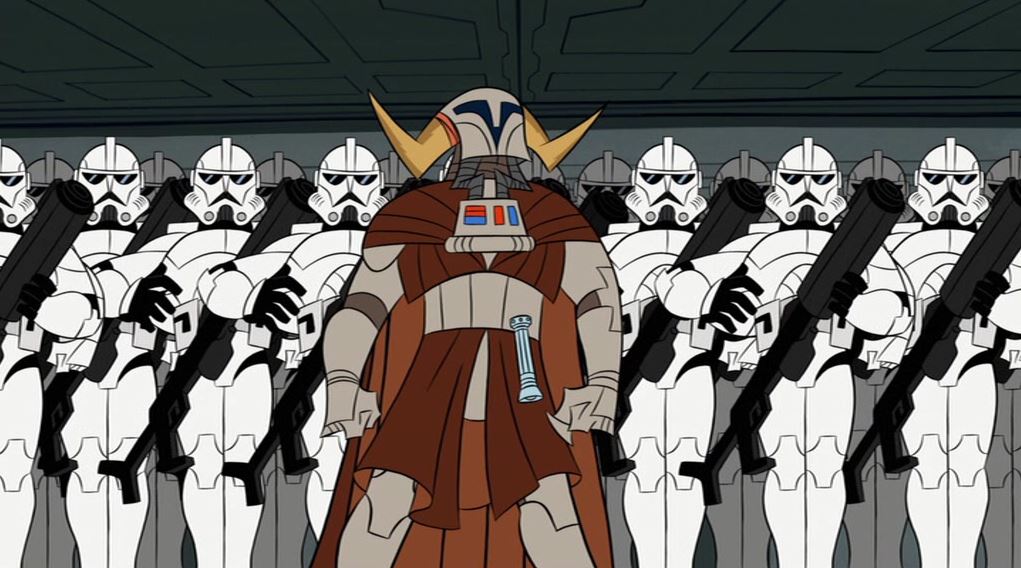
Before The Clone Wars (2008) became the definitive animated saga, there was Clone Wars; a kinetic, stylised microseries created by Genndy Tartakovsky (Samurai Jack). Released in two volumes between Attack of the Clones and Revenge of the Sith, this 2D series is a masterclass in visual storytelling, minimal dialogue, and maximalist action. It’s not canon anymore, but it still hits like a seismic charge.
Watching it again, I was struck by how bold it is. This isn’t just a bridge between films—it’s a mythic war chronicle, told in brushstrokes of speed, silence, and spectacle.
It’s now presented by Disney as two anthology episodes. Each episode comprises on season of the animated shorts. The first volume is a flurry of short, punchy episodes; each one a vignette of Jedi heroism or clone trooper grit. Mace Windu takes down an entire droid army with his bare hands. Kit Fisto leads an underwater assault with a smile. ARC Troopers storm Muunilinst like Republic commandos in a war movie.
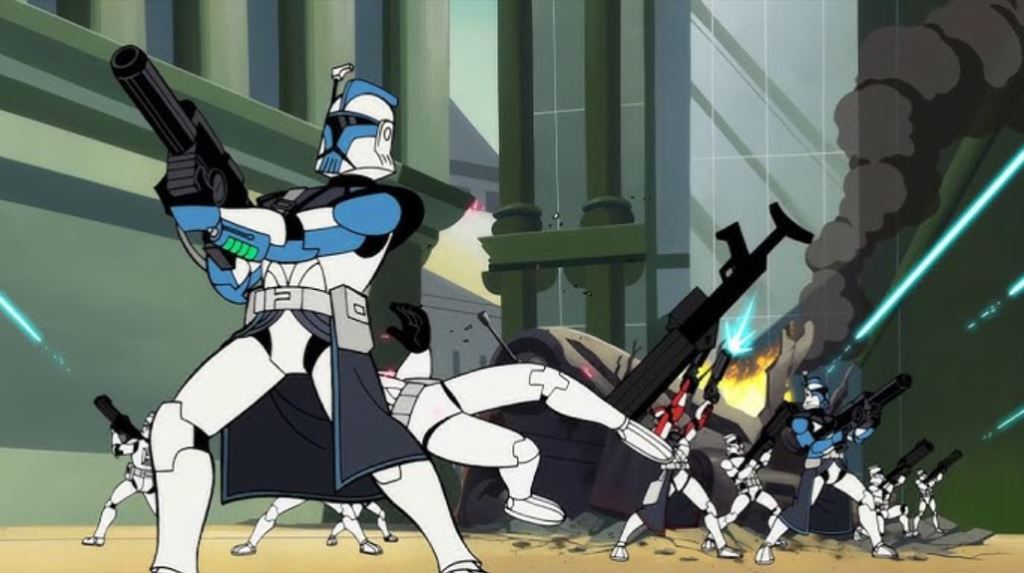
There’s barely any dialogue, and it doesn’t need it. The animation does the talking; fluid, exaggerated, and expressive. It’s Star Wars as kinetic poetry. This use of silence, and this ability to show rather than merely tell, would really improve the actual Star Wars movies. We don’t need everything explained to us, if the filmmakers are fluent in visual storytelling.
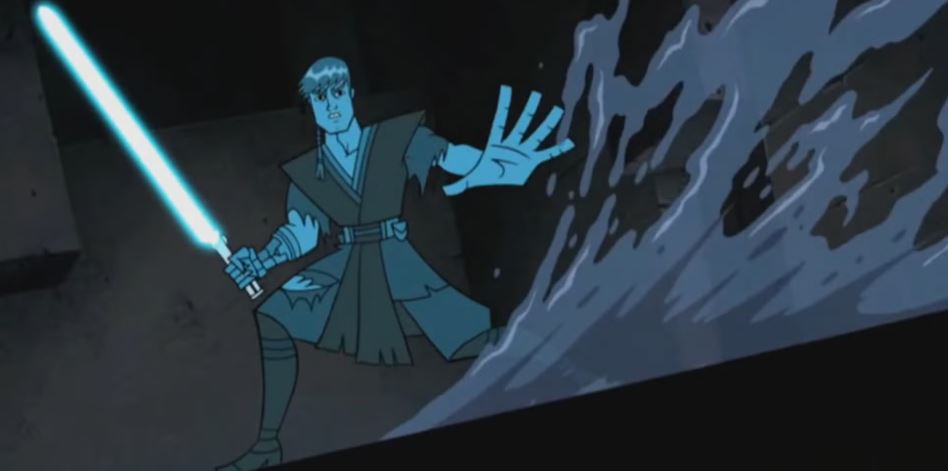
The second volume slows down and darkens. We see Anakin knighted, then slowly unravel as he faces visions of his future and the weight of war. His duel with Asajj Ventress – set in a rain-soaked ruin – is one of the most atmospheric lightsaber battles in the franchise. The lighting is beautiful, rendering each combatant in the colour of their respective lightsabers: Anakin in blue, Ventress in red.
And then there’s General Grievous. Introduced here as a terrifying force of nature, he’s a far cry from the wheezing villain of Revenge of the Sith. His debut is pure, beautiful horror: stalking Jedi in the mist, crushing them with mechanical precision. He’s then shown as an absolute powerhouse later in the series, when he returns to capture the chancellor. Watching him just dismantle a unit of clone troopers is as mesmerising as it is terrifying. This series made Grievous a legend before the film even rolled.
Despite its brevity, the microseries explores a number of key themes:
- The mythic scale of the Jedi: They’re not just warriors; they’re demigods, avatars of the Force in motion.
- The cost of war: Anakin’s transformation is more psychological here, framed through surreal visions and brutal victories.
- The silence of sacrifice: With minimal dialogue, the series leans into visual metaphor and musical storytelling.
It also laid the groundwork for The Clone Wars (2008), introducing characters like Ventress and expanding the war’s scope. It’s part of the larger Clone Wars multimedia project, which included novels like Shatterpoint and Yoda: Dark Rendezvous.
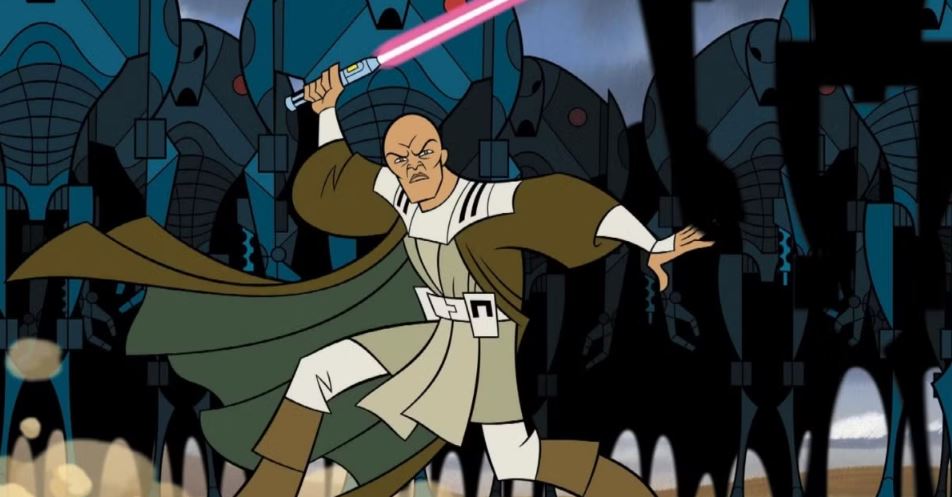
Tartakovsky’s animation is bold and angular, with a rhythm all its own. It’s not realistic, but it’s true in a mythic sense. Every frame feels like a mural. Every movement is a statement. It’s Star Wars as visual opera. A real highlight of this was in the first big battle for the clones. Their poses were heroic, their movement was perfect, and everything about that sequence (which included almost no dialogue) was perfect.
Some throwaway observations:
- Is this the only piece of Star Wars media in which I have liked Mace Windu?
- Anakin spends a lot of time with his shirt off; is this where Kylo Ren gets it from?
- I should go and watch Samurai Jack…
- Ventress is cool, but she’s not really a fully form character yet
- Palpatine, even in his chancellor guide, is bloody sinister in this
- This gives some really good attention to characters who are otherwise neglected; Kit Fisto, Shaak Ti, Ki-Adi-Mundi
- This is fun
Clone Wars (2003) is an absolute gem of a show. It is short, sharp, and unforgettable. It may not be canon any more, but it’s essential viewing for anyone who wants to feel the weight of the Clone Wars. It’s not about lore. It’s about legend.
Rating: 10/10
Come for the style. Stay for the silence. Witness the war.
Next up, I think I’m going to look at the 2008 animated movie, The Clone Wars.
 No Rerolls
2 Comments