

There’s something undeniably compelling about Doctor Strange’s brand of magic. It’s not just the swirling mandalas and gravity-defying set pieces; it’s the way his sorcery feels earned. It’s ritualistic, intellectual, and deeply personal. And for those of us who’ve spent years weaving spells in Mage: The Ascension, it offers a tantalising blueprint for how to make our games feel more cinematic, more metaphysical, and more emotionally charged. We started discussing this in part 1. If you’ve not already read that, it might be worth having a quick scan.
To Strange-ify your Mage sessions is to embrace contradiction. It’s to let your characters be both mystic and scientist, both rule-breaker and guardian. Strange doesn’t abandon his surgical precision when he learns to bend reality; he refines it. His spells are geometric, almost architectural, as if he’s building temporary scaffolding around consensus just long enough to slip through.
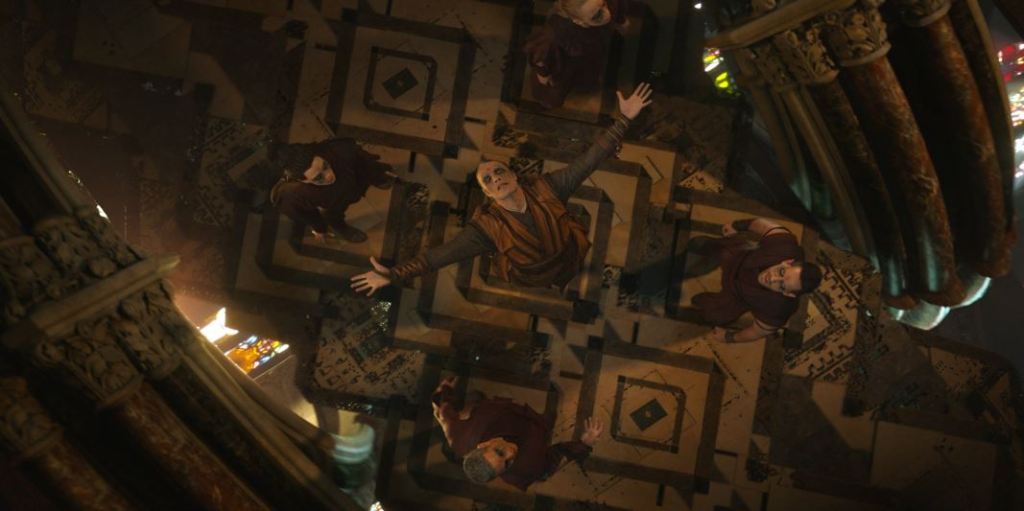
In Mage terms, this is a hybrid paradigm: a worldview that fuses quantum theory with Eastern mysticism, sacred geometry with astral resonance. It’s the kind of belief system that lets a character use Correspondence and Entropy to fold space like origami, or Life and Forces to perform magical surgery with a scalpel made of light. It’s not just about what the spell does; it’s about how the mage sees it.
And then there are the tools. Strange’s magic is never just internal; it’s channelled through relics, grimoires, and sentient cloaks. These aren’t props; they’re extensions of his paradigm. In Mage, we call them foci, but they can be so much more than that. A chronometer that manipulates time, a mirror that reveals alternate selves, a cloak that acts as a semi-autonomous familiar… each one a story in itself, each one a risk and a promise.
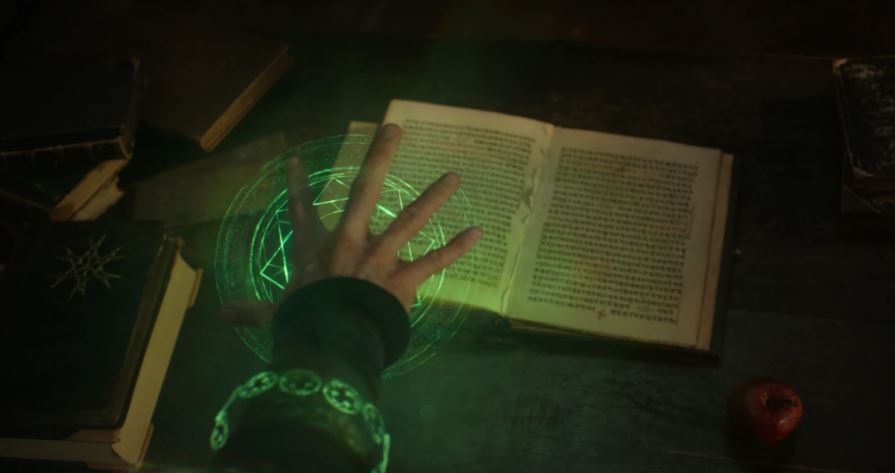
To play a Strange-inspired mage is to treat magic as a conversation with reality. It’s not just “I cast a spell,” it’s “I negotiate with the fabric of the universe.” And sometimes, the universe talks back.
But Strange’s magic is about more than just paradigm and props. It’s also very much about consequence. In Mage: The Ascension, every act of reality-bending carries risk. Now, this risk can be a given amount of mechanical Paradox, but it can also come in the form of narrative weight. Strange is constantly dancing on the edge of that blade. He rewinds time to save lives, and nearly traps himself in a temporal loop. He reads forbidden texts to defeat cosmic threats, and watches alternate versions of himself spiral into corruption. He’s powerful, sure, but he’s also haunted by the cost of that power.

This is where Mage really, really shines. Paradox really should be seen as a punishment mechanic; it’s actually an effective storytelling device. It’s the moment your character sees the cracks in their own belief system. It’s the alternate self who made the wrong choice. It’s the backlash that says, “You’ve gone too far.” Strange’s journey is riddled with these moments, and they make him more compelling than any spell effect ever could.
To Strange-ify your Mage game is to lean into these fractures. Let Paradox be personal. Let it manifest as visions, echoes, or twisted reflections. Let your players confront the selves they might have been: the Marauder who gave in to grief, the Nephandus who justified one too many compromises. Let magic be a mirror.
And then, make it beautiful.

Strange’s spellcasting is never mundane. It’s ritualistic, theatrical, and deeply expressive. He performs as much as he casts. In Mage, we often shorthand our effects: “I use Forces 3 to create a fireball.” But what if we didn’t? What if we described the sigils traced in the air, the whispered mantras, the ley lines aligned beneath our feet? What if every spell was a moment of character revelation?
Encourage your players to treat magic as art. Reward evocative descriptions. Let resonance ripple through the scene. Let the act of casting be as meaningful as the effect itself.
In the end, Strange’s magic isn’t just about bending reality; it’s about who he becomes when he does. And that, more than any Sphere or rote, is the heart of Mage.
 No Rerolls
2 Comments