

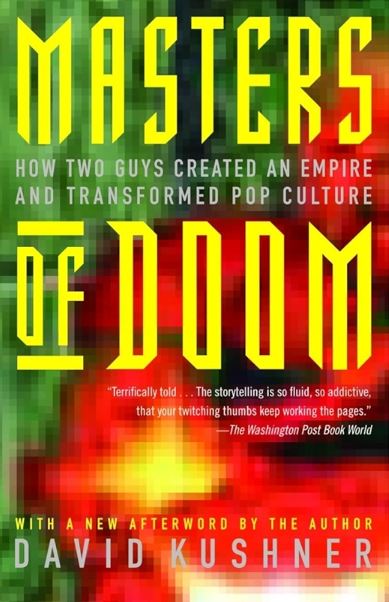
Masters of Doom is a non-fiction narrative book by David Kushner about the foundation of id Software, the creation of the video game, Doom, and the personal and professional lives of John Carmack and John Romero. It came out back in 2003. This review is intended to be free of spoilers, but none of us are perfect. Consider yourself warned! I purchased this book myself; no review copy was provided. There are affiliate links at the end of this review.
Blurb
Masters of Doom is the true inside story of the Lennon and McCartney of the video game industry: John Carmack and John Romero. Together they created an empire, ruled a multibillion-dollar industry, and provoked a national controversy. They lived a unique American dream, escaping their broken homes to co-create the most innovative and notoriously successful video games in history – Doom and Quake – until the games they made tore them apart.
David Kushner has been covering the video game industry for ten years and knows all the angles. Even those with no interest in video games will be fascinated by this vastly entertaining tale of friendship, betrayal and the genesis of a multibillion-dollar popular art form.
Review
Masters of Doom by David Kushner is a narrative nonfiction portrait of John Carmack and John Romero, the two central figures behind id Software and the games that reshaped PC gaming culture, most notably Doom and Quake. Kushner treats their careers as both a technological saga and a human story, tracing a friendship and creative partnership that propelled a subculture into the mainstream and sparked controversies about the medium’s cultural power.
Kushner’s primary strength is narrative momentum. He arranges technical developments, release schedules, and personal conflicts into scenes that read with the drive of a novel, which keeps potentially dry material (engine design, networking, licensing) engaging and comprehensible. Anchoring the story in John Carmack’s technical rigour and John Romero’s theatrical design choices gives the book emotional focus: temperament becomes an explanatory frame for creative risk, rivalry, and the decisions that shaped id’s output. Kushner also places id within its cultural moment, showing how Doom and Quake intersected with nascent online communities, distribution changes, and public debate, which helps readers see the games as cultural catalysts rather than isolated curiosities.
The book’s strengths come with predictable tradeoffs, given the format. The novelistic frame sometimes romanticises events, smoothing business complexity and institutional dynamics into character-driven beats. Structural forces (publishers, platform economics, labour practices, and the contributions of rank-and-file developers) receive only sketchy treatment, which narrows the history to a duet instead of a fuller industrial portrait. Kushner’s reliance on interviews and vivid anecdote favours readability over forensic depth, so readers seeking exhaustive archival documentation or rigorous critique of ethical and workplace questions may find the account wanting. A few middle chapters also slow under dense exposition, interrupting the otherwise propulsive arc.
Taken together, Kushner delivers a lively, accessible origin story that humanises a crucial era in gaming and makes technical material readable for a broad audience. The cost of that accessibility is a somewhat narrowed lens; fewer structural explanations, lighter archival apparatus, and a sympathetic tilt toward the central figures.
Themewise, Kushner spends much of this book tracing creativity as both propulsion and combustive force, showing how technical brilliance and egotistical showmanship can produce revolutionary work while fraying relationships and institutions. The book repeatedly returns to the themes of authorship and credit, interrogating who gets celebrated when collaborative labour and bricolage make a product possible. It also examines the idea of technology as culture: how tools, distribution practices, and online communities reshape aesthetics, social norms, and public anxieties. Finally, there is an ethical undertow; questions about responsibility for cultural effects, stewardship of communities, and what success demands of its makers.
This book is clearly aimed at gamers, but I think the story is pretty universal, and I would recommend it to a more general readership. The book is very engaging; vividly telling an origin story that captures that electric moment when hobbyist ingenuity becomes a commercial force. Kushner’s gift for scene and character transforms technical and business histories into a compelling narrative, and his focus on Carmack and Romero gives the book emotional and explanatory clarity. Yes, that clarity does come at a cost as the book narrows its lens, privileging personality and momentum over structural analysis and archival scrutiny, but I think you have to take this book for what it is. It’s a story. It’s a narrative retelling of history. In that regard, it succeeds in creating a readable, human account of how a handful of people helped reshape games and culture.
Rating: 4/5
 No Rerolls
2 Comments