
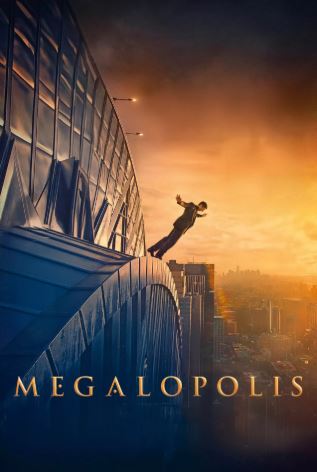
Francis Ford Coppola’s Megalopolis arrives with decades of anticipation behind it, a passion project finally brought to life. It’s a film that aims for grandeur, blending philosophy, spectacle, and operatic ambition. Yet for all its scale, the experience is divisive; moments of undeniable beauty sit alongside stretches that feel heavy‑handed and hollow.
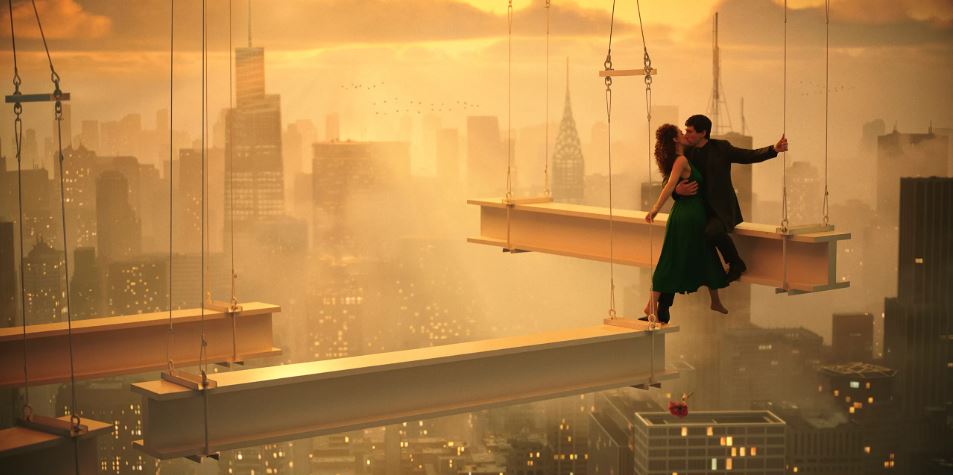
There are flashes of beauty in this film that remind us of Coppola’s eye for spectacle. Vesta’s musical number is the clearest example; a sequence where image, sound, and emotion finally cohere, offering a glimpse of the grandeur the film aspired to but rarely achieved. It’s a moment that feels alive, theatrical, and strangely moving, standing out against the otherwise muddled tone.
The production design also deserves recognition. The cityscapes, with their blend of futuristic ambition and decaying opulence, create a backdrop that is visually striking. At times, the film achieves a dreamlike quality, where architecture and atmosphere feel almost operatic, hinting at the utopian vision Coppola wanted to conjure.
And while ambition alone cannot redeem the film, it is worth noting. Few directors would attempt something of this scale and philosophical reach so late in their career. That willingness to chase a vision, even one that collapses under its own weight, is itself a kind of strength, proof of Coppola’s refusal to settle for smallness.
That said, Megalopolis quickly collapses under the weight of its own pretensions. Coppola seems more interested in delivering philosophy than telling a story, and the result is a film that mistakes grandiosity for profundity. Heavy symbolism is layered over every scene, but without grounding in character or narrative, it feels hollow, like an opera of ideas without a pulse.
The narrative itself is pretty incoherent in places. Plot threads drift without momentum, characters speak in abstractions rather than lived emotion, and the film never builds toward clarity. Instead of weaving its themes into a compelling arc, it indulges in spectacle that quickly becomes exhausting.
Characterisation suffers most. Figures who should feel alive are reduced to mouthpieces, their performances trapped in the film’s abstraction. Even moments of visual beauty, like Vesta’s musical number, only highlight how rare genuine cohesion is. There’s a good cast here, but their performances are hampered by the heavy-handed script.
Finally, the pacing drags. The film feels overly indulgent, stretching scenes far beyond their impact. What should have been a meditation on utopia and decay becomes a slog, weighed down by Coppola’s insistence on spectacle over substance.
What stays with me after Megalopolis is not awe but frustration. Coppola has spent decades chasing this film, and what emerges feels less like storytelling than a monument to ambition. It wants to be philosophy, opera, and cinema all at once, but in trying to be everything, it becomes nothing.
The tragedy is that Megalopolis could have been something great, a late‑career masterpiece that might have distilled Coppola’s obsessions into clarity. Instead, it feels like a director chasing legacy rather than connection, more concerned with being remembered than with being understood. In that sense, the film is less a vision of the future than a cautionary tale about the dangers of mistaking scale for substance.
 No Rerolls
2 Comments