
You know, if season one was a resurrection, season two is an ascension. Interview with the Vampire returned for season two with even greater confidence, the focus from the decadence of New Orleans to the theatrical menace of Paris. The series doesn’t rest on its laurels and instead deepens its characters, sharpens its themes, and revels in the grandeur ofa wider vampire society. What emerges is a second act that proves Anne Rice’s world is inexhaustible, brimming with tragedy, beauty, and the haunting persistence of desire.
If that introduction doesn’t make it clear, I loved it. I should probably give some actual details, though. Let’s crack on.
At the heart of season two for me, as with season one, is Claudia, now portrayed by Delainey Hayles, whose performance captures both the fire and fragility of a vampire forever denied adulthood. Claudia’s journey through Europe is fascinating: she is no longer simply the fledgling caught between Louis and Lestat, but a force of her own, determined to carve out agency in a world that insists on confining her. Her wit and defiance remain intact, but here they are sharpened by ambition and a growing sense of disillusionment, making her arc both heartbreaking and exhilarating.
Claudia’s clashes with Louis reveal the widening gulf between them. His haunted introspection contrasts against her restless hunger for independence. In Paris, her encounters with the coven expose the politics of vampire society, and her refusal to be diminished becomes the season’s most compelling thread. Where season one made Claudia a luminous disruption, season two crowns her as the emotional core: a character whose tragedy is matched only by her brilliance, and whose presence ensures the series never loses its bite.
Season two unfolds in the long shadow of Lestat, and it is Louis who bears the weight of that absence. Jacob Anderson’s performance deepens here, portraying a man haunted not only by memory but by desire. He is unable to sever himself from the intoxicating cruelty of his maker. Lestat may be gone from the stage, but his ghost lingers in every gesture, every hesitation, every confession. Louis’ grief is not clean; it is obsessive, tangled with longing, and it shapes his journey through Europe as much as Claudia’s ambition does.
This absence becomes a paradox: the show thrives without Lestat’s flamboyant presence, yet it refuses to let him go entirely. Louis’ attempts to build a new life, to find belonging beyond the toxic love that defined him, are constantly undermined by the spectre of what he cannot forget. His relationship with Armand offers a new possibility, but it is always shadowed by the question of whether Louis can ever escape Lestat’s hold. In this way, season two becomes as much about survival as it is about love; an exploration of how grief and obsession can bind more tightly than immortality itself.
If New Orleans was a fever dream of decadence, Paris is a theatre of menace. Season two introduces the vampire coven, a troupe that cloaks cruelty in performance, turning vampirism into spectacle. At the heart of this ensemble is Santiago, played by Ben Daniels, who delivers a beguilingly devilish performance that commands the stage at the Théâtre des Vampires. Daniels infuses Santiago with gleeful flamboyance and razor-sharp charisma, making him both trickster and predator. This is a figure who thrives on theatricality and menace. Where Lestat once dominated through charm and violence, Santiago dominates through performance, bending every scene to his will and stealing the spotlight with ease. Simply put, Ben Daniels brought the thunder.
Santiago’s presence underscores the coven’s philosophy: vampirism as art, as performance, as power. His wit is biting, his menace undeniable, and his theatrical cruelty becomes the living emblem of the coven’s ethos. Against him, Louis and Claudia’s sincerity feels precarious, their struggles for agency clashing with Santiago’s dazzling cruelty.
Alongside Santiago, Armand (Assad Zaman) emerges as a quieter but equally compelling force, his enigmatic bond with Louis adding layers of mystery and tension. Together, these new characters expand the world of Interview with the Vampire, proving that Rice’s universe is not confined to New Orleans but thrives wherever vampires gather to weave their dark theatre.
Where season one enveloped us in the humid decadence of New Orleans, season two transports us to Paris, a city rendered as both dazzling stage and sinister labyrinth. The Théâtre des Vampires becomes the centrepiece of this new world, its velvet curtains and candlelit performances transforming vampirism into spectacle. Every detail, from the ornate costumes to the cavernous catacombs and the flicker of gaslight, contributes to a sense of operatic excess. This is a Gothic theatre where beauty and cruelty are utterly inseparable.
The series benefits hugely from this stylistic expansion. Paris feels larger, yet never loses the intimacy that defined the first season. The grandeur of the coven’s performances contrasts sharply with Louis’ haunted introspection and Claudia’s restless ambition, creating a tension between spectacle and sincerity. The cinematography highlights key contrasts: the glittering stage against the shadows beneath, the elegance of Parisian society against the rot of vampiric politics.
It’s not all about spectacle, though. We feel the weight of the show’s themes throughout the course of the season. At its core is grief. Louis embodies this with his inability to escape Lestat’s shadow. Every character experiences it though, and we see it both in Claudia’s growing disillusionment with immortality, and the coven’s obsession with performance as a way to mask emptiness. I like that the show refuses to romanticise eternity; instead, exposing how desire and memory can become elaborate prisons.
Claudia’s arc sharpens the theme of agency. Her hunger for independence collides with the rigid hierarchies of vampire society, making her struggle a metaphor for youth denied and ambition thwarted. Louis’ bond with Armand adds another layer, exploring the tension between intimacy and power, sincerity and manipulation. Their relationship is haunted by questions of belonging: can Louis ever find peace, or is he doomed to repeat the cycle of obsession that began with Lestat?
The Parisian coven embodies another resonance: politics and performance. Vampirism here is not just survival but theatre, a spectacle designed to control both humans and vampires alike. Santiago’s flamboyant, scene-stealing cruelty makes clear that power is inseparable from performance, and that immortality demands masks as much as blood.
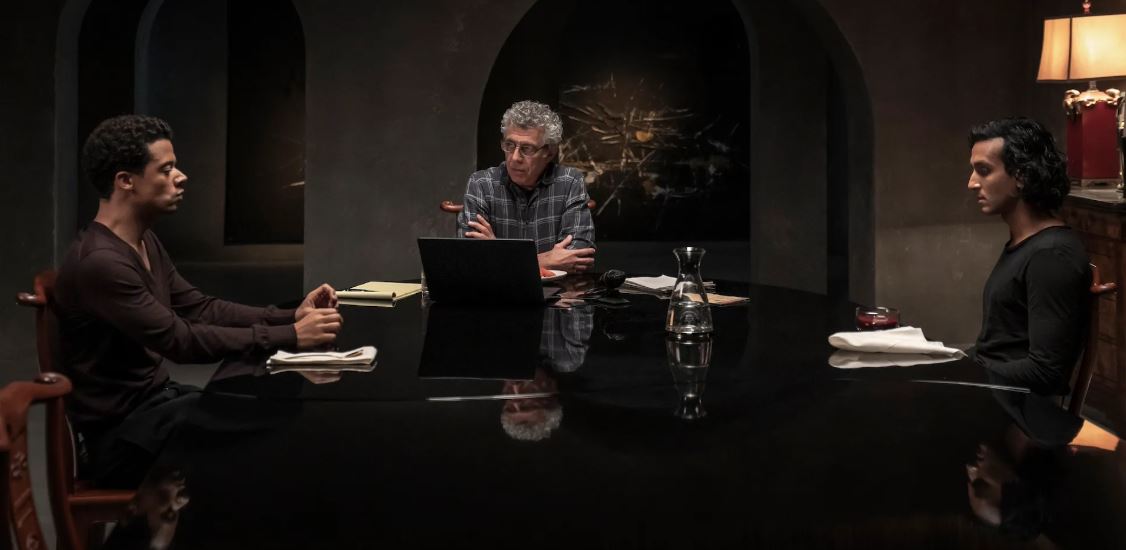
Finally, the framing device with Daniel Molloy, whom I feel is far better utilised this season, continues to interrogate memory and truth. Louis’ story is not a confession but a contested narrative, forcing viewers to question what is real, what is revision, and what is self-deception. In this way, season two becomes a meditation on grief, agency, and the dangerous allure of stories we tell ourselves to survive.
Season two’s greatest strength is its ability to expand the scope of Anne Rice’s world without losing the intimacy that made the first season so compelling. By shifting the drama to Paris, the series embraces spectacle, yet it never sacrifices emotional depth. The Théâtre des Vampires is a triumph of design and atmosphere, a stage that allows the coven’s philosophy of vampirism-as-performance to shine in all its sinister glory.
All that being said… for all its grandeur, season two is not without its stumbles. The absence of Lestat for much of the season, though thematically rich, leaves a noticeable gap in the show’s energy. His flamboyant chaos is missed even as his ghost haunts Louis’ every move. At times, the Parisian coven’s theatricality risks tipping into excess, their performances so elaborate that they threaten to overshadow the emotional core. Have they tried to develop too many of these characters?
Pacing, too, can falter. The series luxuriates in atmosphere and spectacle, but this indulgence occasionally slows momentum, especially when the narrative lingers too long on the mechanics of vampire politics. And while the framing device with Daniel Molloy continues to add intellectual intrigue, its interruptions sometimes feel more disruptive than illuminating.
Yet these weaknesses are minor blemishes on an otherwise dazzling season. They remind us that ambition often comes with excess, and in a show this bold, the excess feels less like failure than part of its Gothic charm.
 No Rerolls
2 Comments