
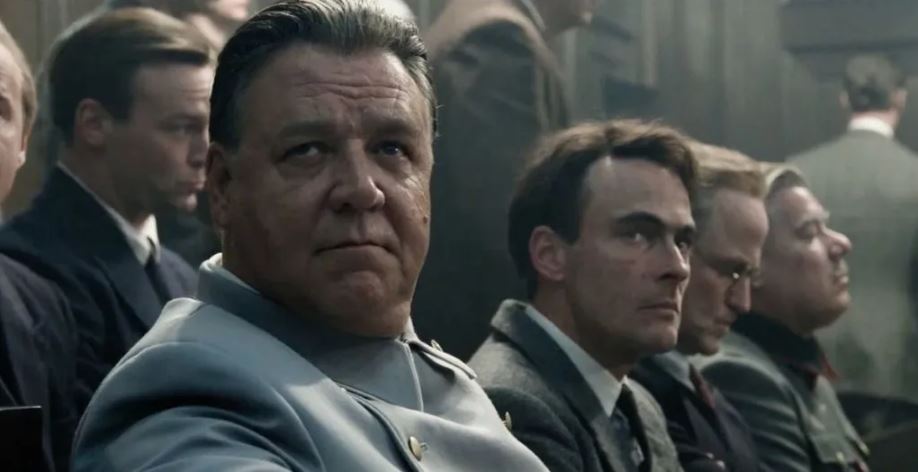
Few historical dramas carry the sheer gravity of Nuremberg. James Vanderbilt’s film tackles one of the most consequential trials in modern history, the prosecution of Nazi leaders after World War II. It does this with a blend of procedural rigour and cinematic sweep. From its opening moments, the film makes clear that it isn’t chasing spectacle for its own sake. Instead, it immerses us in the tense atmosphere of postwar justice, where the stakes are not just legal but existential: can humanity hold its worst offenders accountable, and can law itself rise to meet atrocity?
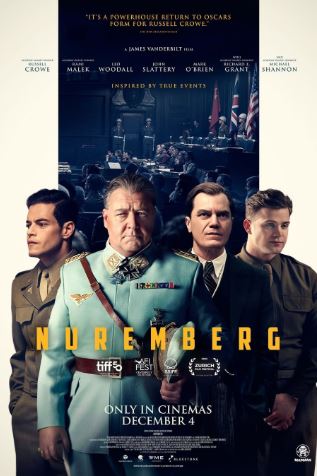
Anchored by a powerhouse cast that includes Russell Crowe, Rami Malek, Michael Shannon, among others, the film positions itself as both a courtroom drama and a moral reckoning. It’s a story about evidence and arguments, but also about conscience, responsibility, and the fragile hope that justice can be more than vengeance.
The film’s greatest strength is its sense of gravity without sensationalism. James Vanderbilt resists the temptation to turn history into spectacle, instead crafting a drama that feels tense, deliberate, and morally urgent. The pacing is remarkably steady. It never seemed to drag, and was definitely not guilty of rushing us along. I feel that it allowed the arguments, testimonies, and humanity – flawed as it often is – to unfold with clarity and weight.
Michael Shannon’s portrayal of US Supreme Court Justice Robert H. Jackson is a standout presence. His performance anchors the film with a mix of authority and humanity, embodying the moral struggle at the heart of the trial. He becomes the audience’s compass, reminding us that justice is not abstract but lived through the choices of individuals.
The ensemble cast adds further strength. Rami Malek delivers a typically nuanced portrayal that captures the enormity of the task before the allied characters. The supporting players ensure that the trial feels populated by real, conflicted people rather than archetypes. Together, they create a world that feels authentic, layered, and deeply human.
The most noticeable issue with this movie, for me, lies in Russell Crowe’s performance, which feels uneven compared to the rest of the ensemble. While the role demands gravitas, his delivery sometimes slips into heaviness that slows the energy of key scenes. And that accent? I just feel that Crowe is well past his prime.
The film also struggles occasionally with narrative density, though that might be unavoidable, given the subject at hand. By trying to cover so many strands of legal argument, psychological analysis, and political context, it risks overwhelming the viewer. The clarity of the trial’s moral stakes remains intact, but the sheer volume of surrounding detail can make the story feel crowded.
Nuremberg succeeds as a good, well‑paced historical drama. By refusing to sensationalise, it allows the gravity of the trial to speak for itself, and the steady pacing ensures that the film never drags nor rushes through its weighty subject matter. Anchored by mostly strong performances, the film balances moral urgency with clarity, making the heated exchanges compelling rather than overwhelming.
Even with some uneven performances and moments of narrative density, Vanderbilt’s direction keeps the story moving with purpose. The result is a film that feels both respectful of history and engaging as cinema: deliberate, thoughtful, and ultimately rewarding. I’m not sure that “enjoyed” is an appropriate word to describe my feelings about a movie that unpicks historical atrocities, but it was definitely an excellent film.
 No Rerolls