
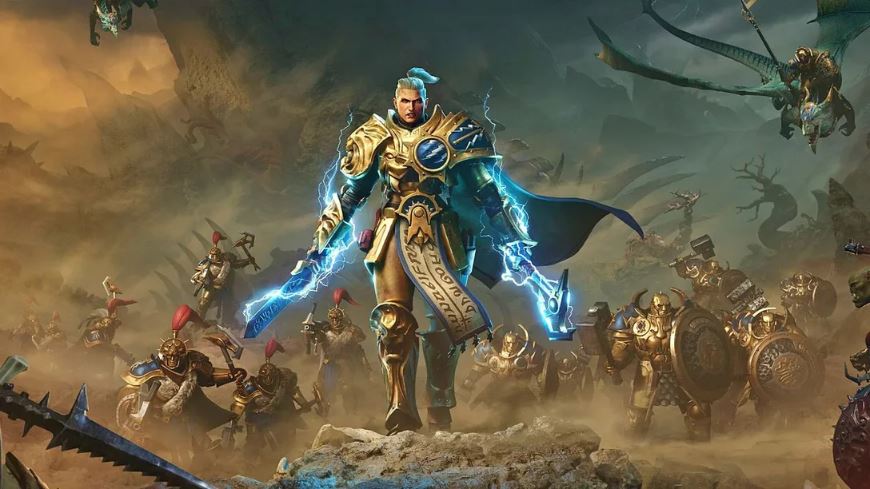
This article is part of a retrospective series marking the 10th anniversary of Warhammer: Age of Sigmar. From the shattering of the Old World to the rise of the Mortal Realms, we’re exploring a decade of mythic storytelling, strategic evolution, and community transformation. Whether you marched with the first Stormcast or joined the fray in the Age of the Beast, this series is for you: the generals, the lorekeepers, the hobbyists, and the dreamers. Welcome back to the Mortal Realms.
Series Contents:
- Introduction: The Storm Breaks
- The Shattering of the Old World
- Editions through the years
- Factions and Icons
- Community and Culture
- Thematic Legacy and Design Philosophy
- The next 10 years (you are here)
A Realm Still Forging
Ten years ago, Age of Sigmar began with a cataclysm. Today, it stands as a mythic colossus; rich in lore, refined in design, and alive with community. But the Mortal Realms are not static. They churn, evolve, and beckon us toward what lies beyond the horizon. Here are a few broad predictions about the next decade…
1. The Realms Will Deepen
Many realms – Ulgu, Hysh, Azyr – remain tantalisingly half-seen. Over the next few years, players may finally walk their shadowed corridors or bask in their radiant courts. These settings are rich with untold myth:
- Ulgu, where deception isn’t treachery; it’s tradition.
- Hysh, where light itself judges thought and action.
- Azyr, the divine fortress, whose gates have remained mostly shut to us.
Deeper exploration means more unique cultures, distinct battlegrounds, and philosophies that challenge what we think of as “Order” or “Chaos.” Further development of the Soulbound RPG line can facilitate meaningful and more granular exploration

2. Narrative Will Shape Gameplay
The rise of Path to Glory, realm-specific rules, and faction identity hints at what’s hopefully next as a design approach: a tighter fusion of story and mechanics. Imagine:
- A more developed campaign system, perhaps where your army’s past defeats haunt them with penalties.
- Realms that change over time, altering terrain and magic, as we saw over the course of the third edition with our exploration of Ghur.
- Characters who evolve across books—not just narratively, but tactically.
AoS began mythic and should remain so on the grand scale. The future, however, may be personal, where your choices forge your army’s soul as well as its strength.
3. The Community Will Lead
From fan-made campaigns to diversity-driven projects, the AoS community has proven it’s more than an audience; it’s a co-author. We’ve seen this over the past ten years. Games Workshop was only able to salvage and further develop Age of Sigmar because of a community that gave it a chance and committed to it. Over the next decade:
- We’ll see more campaigns shaped by, and tournaments hosted by, players within the community.
- The hobby space will continue to broaden, welcoming new voices, styles, and perspectives.
- Shared storytelling and hobby work, not just competition, will define the pulse of the realms.
The most powerful god in the Mortal Realms? Perhaps it’s the imagination of the people who play in them.
Endings Are Just Beginnings
That’s a statement that Age of Sigmar players should know better than most. Our game rose from the ashes of another, after all. Ten years later, it stands ready for new myths, new mechanics, and new heroes. Not every battle will be epic. Not every warband will be remembered. But each roll of the dice, each brushstroke, each story whispered across a table; that’s how the realms grow.
As we come to the end of this series of posts, it’s worth hammering the point that The Mortal Realms were never meant to be finished; they were forged to be felt. Over seven chapters, we’ve walked the shifting paths of Sigmar’s storm, traced the arcs of gods and mortals, and seen how myth is shaped not only by rulebooks but by the hands that roll the dice. Whether you’re an old soul from the Old World or you were a fresh spark from the Era of the Beast, your story adds to the storm.
The next chapter? It’s yours to write.
 No Rerolls
2 Comments