
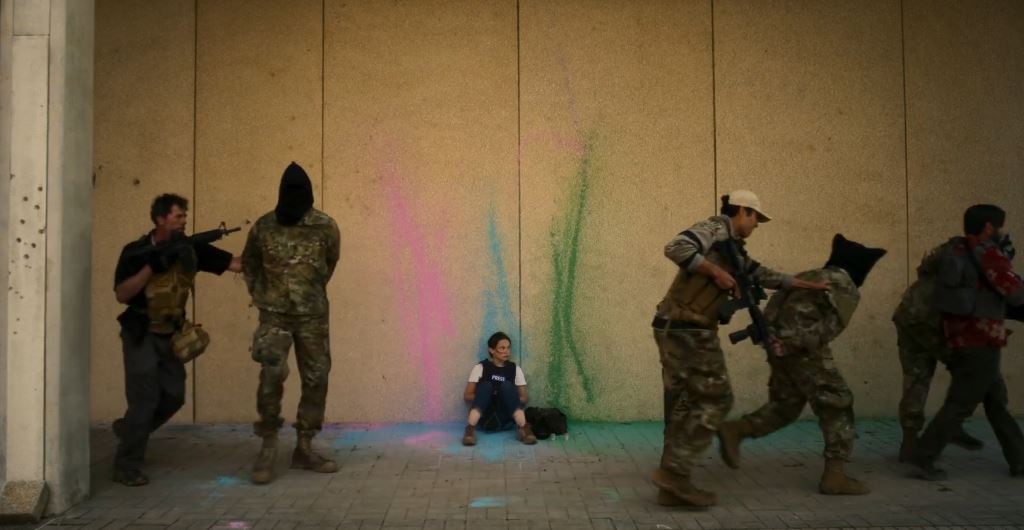
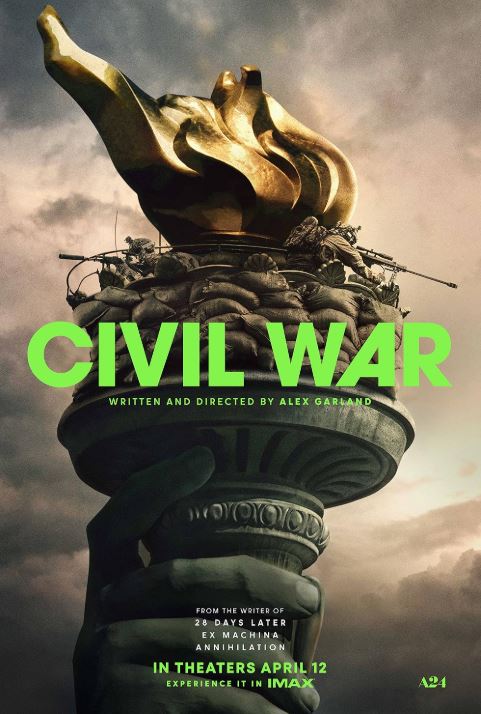
Alex Garland’s 2024 film, Civil War, is not a comfortable film. It’s not meant to be. From its opening frames, it drags the audience into a near-future America fractured by internal conflict, and it refuses to let us look away. What unsettled me most wasn’t the spectacle of combat or the collapse of institutions; it was the plausibility. The idea that a society could regress so quickly, so easily, into violence and division.
The film follows a group of journalists navigating a war-torn United States, documenting atrocities and trying to survive long enough to tell the story. Garland’s choice of perspective is crucial: we don’t see the war through soldiers or politicians, but through witnesses. Their cameras become our eyes, forcing us to confront the human cost without the filter of ideology.
Watching as a non-American, I couldn’t help but wonder: is this outcome uniquely American? The film leans heavily on cultural markers that feel distinctly tied to the U.S. We see the ubiquity of firearms, the mythology of patriotism, the deep polarisation of politics. Guns in particular are poignant symbols of how quickly disputes escalate into violence when lethal force is normalised.
Patriotism, too, is weaponised. The film shows how national pride can fracture into competing visions of what “America” means, each side convinced it owns the true narrative. That tension feels rooted in the American psyche, where the flag is both unifying and divisive.
It’s tempting to breathe a sigh of relief and say: “That couldn’t happen here.” Britain doesn’t have the same saturation of firearms, nor the same intensity of patriotic iconography. Our divisions tend to play out in words, votes, and protests rather than armed militias. But complacency is dangerous.
The UK has its own fault lines along regional identity, class divides, political polarisation, and economic strain. We’ve seen how quickly rhetoric can harden into hostility, how communities can fracture under pressure. Without the gun culture, a British “civil war” might not look like Garland’s America. It might be slower, quieter, fought through institutions, media, and social unrest rather than open combat. But the risk of regression – the erosion of trust, the collapse of dialogue – is not uniquely American.
What Civil War reminds us is that democracy is fragile everywhere. The film is a warning, not just to the U.S., but to any society that believes itself immune to collapse.
The performances of the cast ground Civil War in lived reality. Garland’s choice to centre the story on journalists means the cast must balance detachment with vulnerability, and they do so with remarkable precision. Kirsten Dunst delivers a weary, haunted turn as a veteran photojournalist, her every glance weighted with the exhaustion of witnessing too much. Cailee Spaeny, as her younger counterpart, embodies the tension between idealism and disillusionment, her wide-eyed determination slowly eroded by the brutality around her. Together, they form a dynamic that feels painfully authentic: the mentor who has seen too much, and the apprentice who is learning what that means.
Nick Offerman’s appearance is brief but unforgettable. Known to many for his dry wit and warmth, here he channels something entirely different: authority laced with menace. As the President, he acts as a symbol, an embodiment of power clinging to legitimacy in a fractured nation. Offerman’s performance is chilling precisely because it is understated. He doesn’t rant or posture; he delivers his lines with a calm, almost bureaucratic certainty that makes the violence around him feel all the more horrifying. It’s a reminder of how quickly charisma can curdle into control, and how dangerous quiet conviction can be in the wrong hands.
Other supporting players add texture to the journey. Wagner Moura brings a restless energy, a sense of reckless drive that contrasts sharply with Dunst’s restraint. Jesse Plemons, in a harrowing cameo, embodies the banality of cruelty. His casual interrogation scene is one of the film’s most disturbing moments, precisely because it feels so plausible. Each performance contributes to the film’s atmosphere of dread, making the collapse of civility feel not just possible, but inevitable.
The sniper sequence is, for me, the film’s most harrowing moment, and my favourite scene. It strips away the chaos of battle and distils the horror of civil conflict into something cold and precise. The journalists find themselves pinned down, unable to move, every step measured against the unseen scope of a rifle. Garland stages it with unbearable tension. complete with long silences punctuated by sudden violence, the camera lingering on faces as fear and calculation take hold. What unsettled me most was not just the danger, but the banality of it: one man, hidden, methodical, reducing human lives to targets. It’s a scene that captures the fragility of safety in a fractured society, and it lingers because, again, it feels so plausible.
Civil War is upsetting because it feels possible. Garland doesn’t present a dystopia so much as a mirror tilted slightly forward in time. For Americans, it’s a direct confrontation with their own cultural fissures. For those of us watching from abroad, it’s a reminder to examine our own.
The question isn’t whether we would fare better in the UK. The question is whether we’re willing to recognise the cracks before they widen.
 No Rerolls
Thanks for the write-up! I’ll have to track this one down!
LikeLike