

The Collapsing Empire was written by John Scalzi, and published by Tor in 2017. As with most of Sclazi’s work, this novel sits firmly in the sci-fi genre. It is the first of three books in the Interdependency series. I have read the book several times in physical and audiobook formats. This review is intended to be free of spoilers. This review is not based on a free or review copy. There are affiliate links at the end of this review.
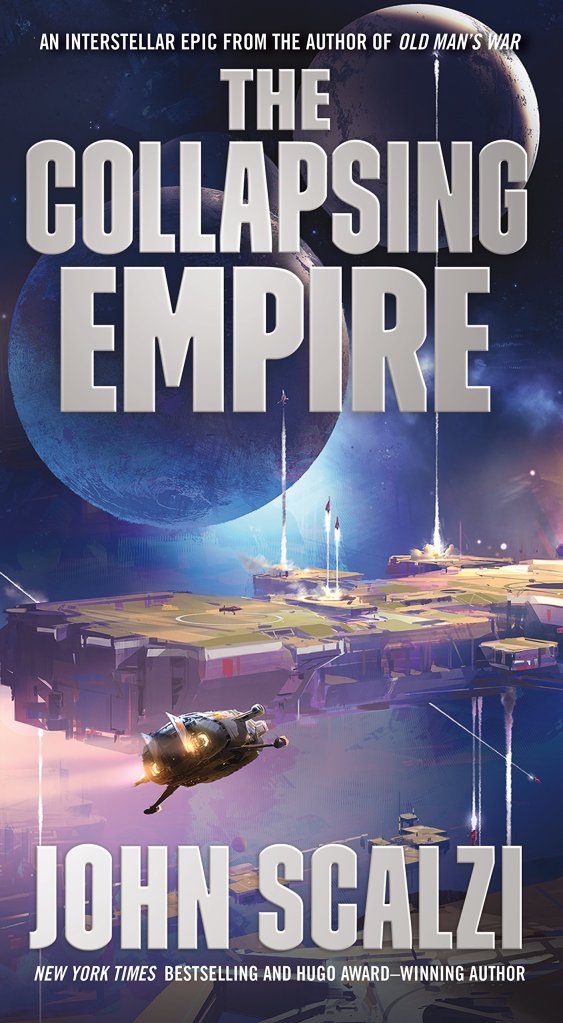
Blurb:
In the far future, humanity has left Earth to create a glorious empire. Now this interstellar network of worlds faces disaster – but can three individuals save their people?
The empire’s outposts are utterly dependent on each other for resources, a safeguard against war, and a way its rulers can exert control. This relies on extra-dimensional pathways between the stars, connecting worlds. But ‘The Flow’ is changing course, which could plunge every colony into fatal isolation.
A scientist will risk his life to inform the empire’s ruler. A scion of a Merchant House stumbles upon conspirators seeking power. And the new Empress of the Interdependency must battle lies, rebellion and treason. Yet as they work to save a civilization on the brink of collapse, others have very different plans . . .
Review:
I like political sci-fi. It’s why I enjoyed The Expanse. It’s something I loved about the Star Wars Expanded Universe. I like political sci-fi. Well, it seems that John Scalzi likes it, too. This is a space opera that has a good slice of action, but is mostly conversational.
The Collapsing Empire unfolds in a vast interstellar empire known as the Interdependency (or, more fully, the Holy Empire of the Interdependent States and Mercantile Guilds), where different human settlements are connected by a network called the Flow. The Flow enables effective faster-than-light travel in a setting where true faster-than-light travel does not exist. In fact, it’s the only real method of communication and travel between the far-flung settlements. The stability of this empire is threatened when it is discovered that the Flow is collapsing, potentially isolating settlements and leading to the empire’s demise. The story follows a diverse cast of characters, including Emperox Grayland II and the shrewd merchant Kiva Lagos, as they navigate political intrigue, power struggles, and the impending collapse of the empire. The third character to round off the central three is Lord Marce Claremont, a Flow Physicist working to understand and communicate the problem of the Flow collapse.
These three central characters are all very compelling. There are chapters from the point of view of each of them, so you do get a good sense of their inner monologue, and their motivations. You get a real sense in particular of the burden of leadership on the shoulders of an Emperox who never wanted to job and is now in the position of being one of the most consequential rulers that the Interdependency has ever known. Of the three main characters, I think Kiva Lagos, the foul-mouthed daughter of a prominent mercantile family, probably sees the most personal growth, which is continued throughout the rest of the series.
The best thing about this novel is probably the world-building. Scalzi creates a really interesting setting. This is a sci-fi empire with three main institutions. Namely, these are the Church, parliament, and the mercantile guilds which are run by the noble families. Having a foot in each camp, as the nominal leader of the Imperial House, a member of parliament, and the head of the church, is the Emperox. The Flow, and the structure of the paths created by it, dictate the economic structures of the empire in the same way that access to major rivers led to the development of cities as trading hubs in our own history. The mercantile guilds and the associated houses create an aristocracy and, through the existence of their legally-enforced monopolies, the independence after which the empire is named.
The novel, as is typical of those by Scalzi, combines humour, sharp dialogue, and social commentary, creating a riveting space opera that sets the stage for further exploration in The Interdependency series. The female characters developed in the novel are particularly compelling, with Kiva and the Emperox being particularly good, along with the fascinatingly arch Nadashe Nohamapetan, daughter of another powerful noble house.
I read the book, but I also listened to the audiobook. It’s narrated by Wil Wheaton. I understand that views on Wheaten can be quite divided, but I think he is a fantastic narrator. He narrates all of John Scalzi’s books outside of his Old Man’s War series, and he is consistently excellent. He shows a good vocal range, is not grating, and is able to make each character sound unique and likeable. He’s also able to voice female characters in a way that isn’t jarring. That’s really important as most of the important characters in this book are female. Seeing Wil Wheaton’s name listed as a narrator is now a big draw for me when it comes to choosing an audiobook.
With all of the above, it should come as no surprise that I very much recommend this book. I love it. I’ve re-read it several times, and I’ve grabbed elements of it to use in games of Traveller. The humour, charm, compelling characters, and excellent world-building all combine to make this one of my favourite novels.
This is the first straight-up book review I’ve done on the site, so I’ve never really worried about assigning a rating. With a view to doing more book reviews in the future, I suppose I should start. Let’s go with a classic 5-point rating.
Rating: 5 / 5
 No Rerolls
I like Scalzi’s work, though I hadn’t read any for a while.
Until I read Starter Villain, which is hilarious. If you’re a fan of his books, I highly recommend it.
LikeLike
it’s sitting next to me, waiting to be read. but then Red Side Story by Jasper Fforde came out, so that takes priority.
LikeLiked by 1 person
My introduction to Scalzi was Redshirts. That was enough to pay attention here when I saw his name. They sound like a really good read. Thanks for the recommendation – I’ll be looking for them.
LikeLiked by 1 person
I think he’s gotten way better since redshirts. His more recent books are fantastic.
LikeLiked by 1 person
I read this a few years ago on the recommendation of a friend. I found it very engaging and enjoyable, and I’m not really sure why I didn’t read the rest of the trilogy. Maybe it’s time to rectify that.
LikeLike
I love all three. The middle one might be my favourite, just for how satisfying the ending is.
LikeLike