
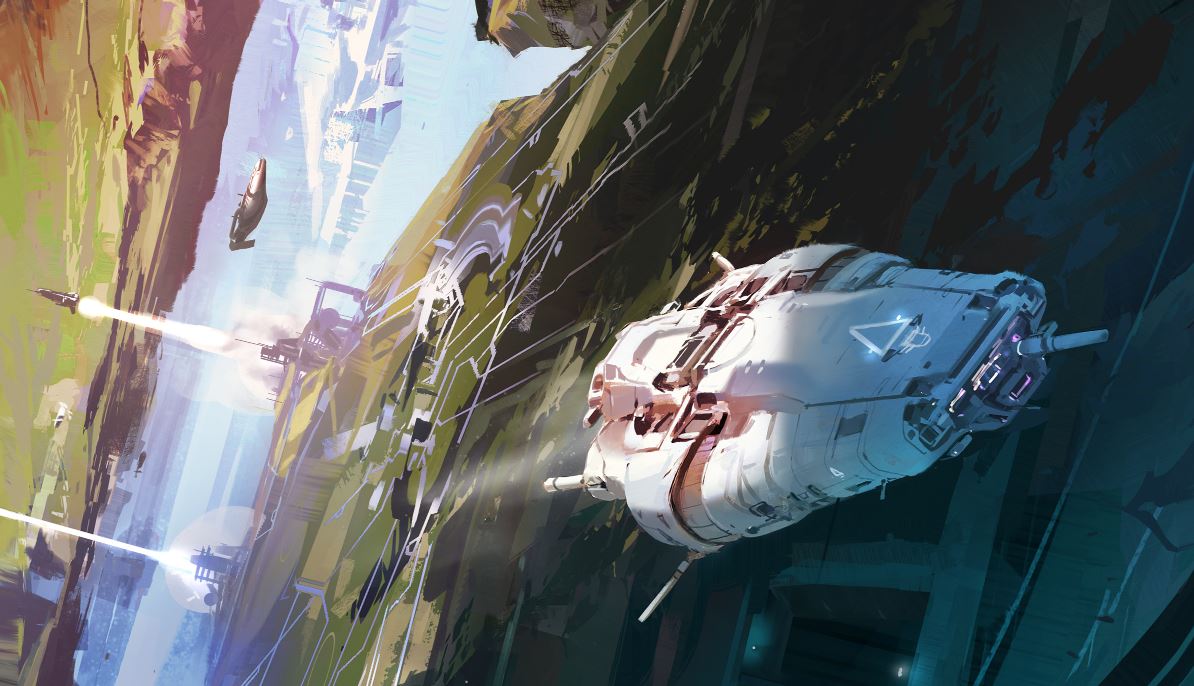
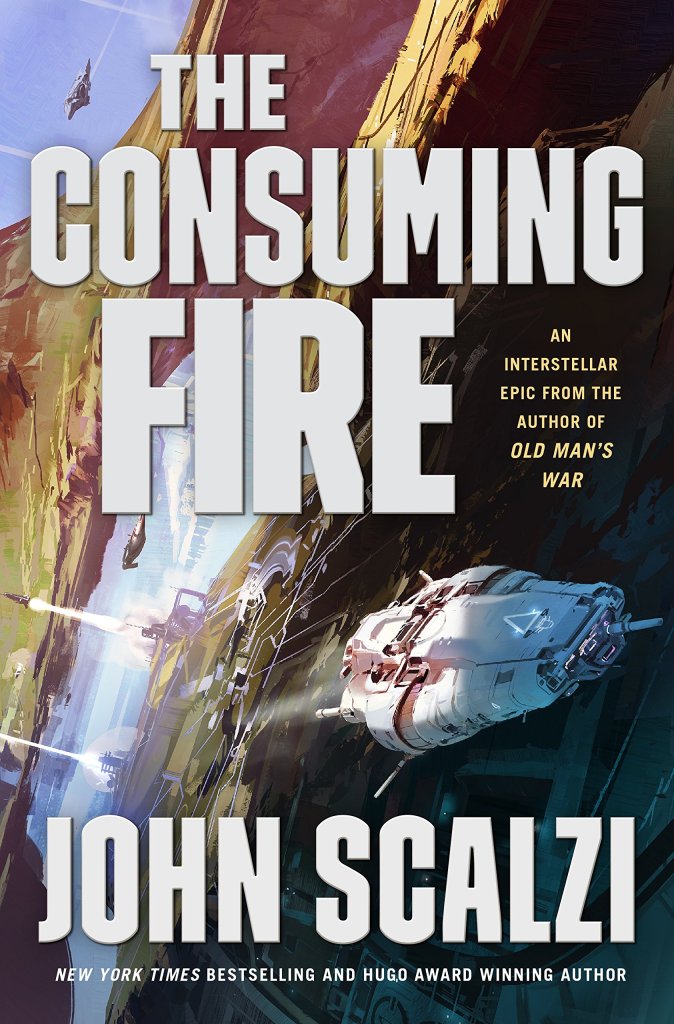
The Consuming Fire is a sci-fi novel written by John Scalzi, and published by Tor in 2018. It is the second of three books in the Interdependency series, the first of which I have previously reviewed. I have read the book several times in physical and audiobook formats. This review is intended to be free of spoilers for the book itself, but will likely contain spoilers for the previous book in the series, The Collapsing Empire. This review is not based on a free or review copy. There are affiliate links at the end of this review.
Blurb:
The Interdependency, humanity’s interstellar empire, is on the verge of collapse. The Flow, the extra-dimensional pathway between the stars, is disappearing, leaving planets stranded. Billions of lives will be lost – unless desperate measures can be taken.
Emperox Grayland II, the leader of the Interdependency, is ready to take those measures. But it’s not that easy. There are those who believe the collapse of the Flow is a myth – or an opportunity for them to ascend to power.
While Grayland prepares for disaster, others prepare for civil war. A war that will take place in the halls of power, by the altars of worship and amongst the titans of industry as much as between spaceships. Nothing about this power struggle will be simple or easy . . . and all of human civilization is at stake.
Review:
As I mentioned when I wrote about The Collapsing Empire, I really like political sci-fi. Whilst the previous book in this series really embraced political sci-fi, it’s ramped up here and the plots and intrigue grow ever denser and more fascinating. Emperox Grayland II finds herself embroiled in the schemings of her established enemies in the House of Nohamapetan and her (supposed) own House of Wu. All the while, Lord Marce Claremont continues to try to persuade the Interdependency of the coming collapse, the civil war on End rumbles on, and lady Kiva Lagos embarks on a new and dangerous stage of her mercantile career.
The Consuming Fire returns us to the interstellar empire known as the Interdependency (or, more fully, the Holy Empire of the Interdependent States and Mercantile Guilds), which is facing immininent collapse as the Flow, a series of interstellar paths that facilitate fast travel in a universe in which faster than light travel is not otherwise possible. The stakes are high right from the start of the book, largely due to the prep work that was done in the first novel. Whilst Grayland has imprisoned her rival (and would-be assassin), Nadashe Nohamapetan, the instability of the situation continues to further destabalise her rule. At the same time, Grayland is claiming revelation. She tells the Interdependency of her visions of the future.
These vision are where the next bit of world building comes in. The Inderdepency was built on prophecy; the first Emperox was the Prophet Emperox Rachela. Whilst doctrinarily Grayland II is within her rights as leader of the church and successor to Rachela, she is the first Emperox in over 1,000 years to claim prophecy. That she does this whilst simualtaneously sending out her scientific advisor, Lord Marce, to argue the science of the impending collapse is problematic to many. The situation is tense.
The plots set in motion, from the established villains of the House of Nohamapetan and the previously unknown cousins of the House of Wu, along with strife among the other noble houses form the backdrop of this story. It again follows our three compelling main characters of Grayland, Kiva, and Marce and you see growth in all of them as things go on. Once again, Kiva sees the most real character development and growth, whilst Marce is largely unchangingly earnest and Grayland is just increasingly tired and frustrated. That burden of leadership we saw on her shoulders before is only growing larger and more cumbersome.
In addition to our main characters, we do see some interesting new characters. The Countess Nohamapetan is a really great villain; a powerful and threatening presence. The Nohamapetan lawyer, Senia Fundapellonan, is a surprisingly interesting and important character who drives the development of another character in surprising ways. Hatide Roynold is another fantastic character who acts to challenge Marce’s seeming infallibility in flow physics up to this point. My favourite new character, however, is one Tomas Reynauld Chenevert. I cannot tell you anything about this character without pretty massive spoilers, so I won’t go into it. But yeah; he’s the bestest. I love the concept, the relationships he develops, and how Wil Wheaton voices him in the audiobook.
The best thing about this series, as we have previous established, is definitely the world-building. Scalzi created an interesting setting in The Collapsing Empire and fleshes it out really well here. The institutions we came to know previously (namely the church, parliament, and the mercantile guilds) are further developed. I feel we particualrly get a better insight into the church. The parliament is the institution that isn’t really developed, and it isn’t really properly explored anywhere in the series. It’s a bit disappointing, as it feels like something of a blind spot.
The novel has sharp dialogue, social commentary, and a well-structured story that works as both the middle section of a series, and as a standalone story. The pacing is fantastic. The story is broken up really well and the way that the main characters are dealt with individually makes them feel important, and then it’s very satisfying when they come together for various shared scenes. There’s an expedition as part of this story that is a particularly exciting and interesting section of the narrative. My favourite part of the story comes late on. The title of the story comes from a line of dialogue that is uttered by an important character. It’s amazing when that payoff comes and the phrase is said. I got chills. That scene is amazing, and dramatic, and satisfieds, and earned. That last bit matters. The big story beats are earned.
As with the previous book, the audiobook for The Consuming Fire is read by Wil Wheaton. He does a great job. He’s really getting to know the characters by this point and he slides back into them with confidence. I love how he’s able to really show the social standings of different characters with shifts in tone. It’s an excellent recording.
I recommend this book. I love this book. It’s this series’ version of The Empire Strikes Back, in that it’s probably the strongest entry in the series. Any slight doubts you may have about the plot as we go along are remedied by the ending. Whilst the first book established a setting and introduced an existential threat, this book explores the first realisation that this threat might be real. Thatstarts with denial. It starts with hostility, denial, and anger. We’re seeing a society crumble before us, and it’s really fascinating.
Rating: 5 / 5
 No Rerolls
3 Comments