
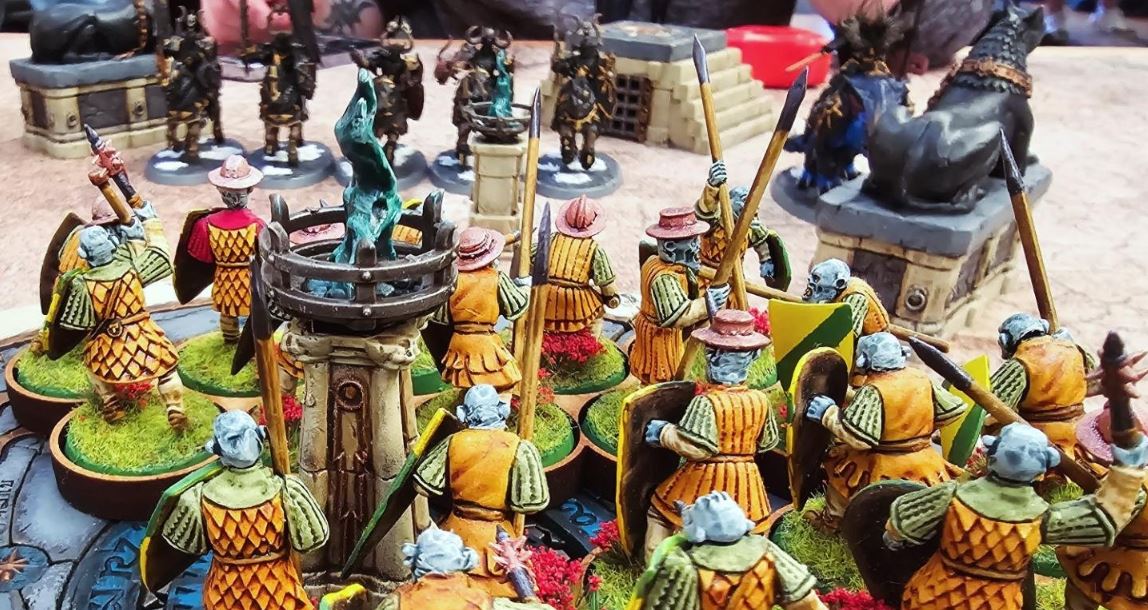
On Thursday, I had my first play of Age of Fantasy, the AoS-like ruleset from One Page Rules. I shared the list I intended to use before the game. On the day, I made some tweaks to the list, splitting the big unit of knights into two smaller units and attaching my Prophetess to the kitted-out unit with the command group.
My opponent used his AoS Chaos Warriors, bringing two units of knights, a unit of warriors, a chaos spawn and a lord on demonic mount. We set out our usual Age of Sigmar terrain, grabbed a copy of the rules and the online army list builder and we were good to go!
You can click here to visit OPR’s webpage for Age of Fantasy and here to see the fantastic army builder.
The army builder, by the way, is fantastic. The rules are very short – as one would expect from an outfit known as One Page Rules – with one side of the page describing the rules and another going through many of the universal special rules, the army builder fills in some gaps. You can click on a USR to view it within the builder, but it also includes the same click-to-view feature for your army’s unique rules. On the entry for my knights, for example, I could click on the universal Impact rule, but also my army-specific Joust rule. It’s really handy, accessible, and just easy.
The goal of the game was to hold more objectives at the end of turn 4. We had 5 (D3+2) objectives on the table. We began the game 24 inches apart. This seemed like a long way, but there’s actually a lot of movement range in the game. Standard movement is 6 inches, but units run or charge 12 inches, with mounts and command groups adding further movement to many units. The lack of randomised running and charges means that the game is a lot more predictable, and you are very much rewarded for effective positioning of counter charges. The fact that the game uses alternating activations makes this a lot more possible that it might be in a full-turn-based game like AoS.
Combat feels pretty deadly. There’s a roll to score a hit, and then a defence roll. Most units have a single attack and a single wound. Small units, like knights, will find it difficult to chew through large blocks of infantry. Certainly, in my game, my bit units of 20 infantry were generally able to hold their on against knights that definitely outclassed them, but which could not deal with the number of bodies they faced. It does help that you’re not trapped in combat, though.
I had a lot of fun with the game. My knights were a mixed bag. One unit did well and another did very little. My opponent’s experience with his two units of knights was the same, actually. In hindsight, I probably shouldn’t have taken the lord on hippogryph. I think I’d have got more out of a leader for the infantry who would have made them much more effective in combat. The big beastie didn’t really do all that much.
In the end, I managed to scrap a win by limping my heavily-damaged hippogryph onto an objective, swarming another with my undamaged infantry unit, and retreating my damaged infantry onto a third point.
I enjoyed the game, and it’s something we’ll return to, I reckon. It’s simple enough and is quite a happy, little game. I do feel the descriptions of the armies are quite… plagiaristic. They’re pretty directly just the AoS and WFB armies with alt names. And, you know, that’s fine. I like the sheer number and range of armies available. There are also a load of OPR STLs, should you wish to use their ‘official’ models, though the mini-agnostic nature of the game is a major selling point.
Will it be a regular feature at out tables? Probably not. Will it see some play? I think so. It’s fine, but it does lack a bit of depth and complexity. Then again, is that not the point?
 No Rerolls
11 Comments