
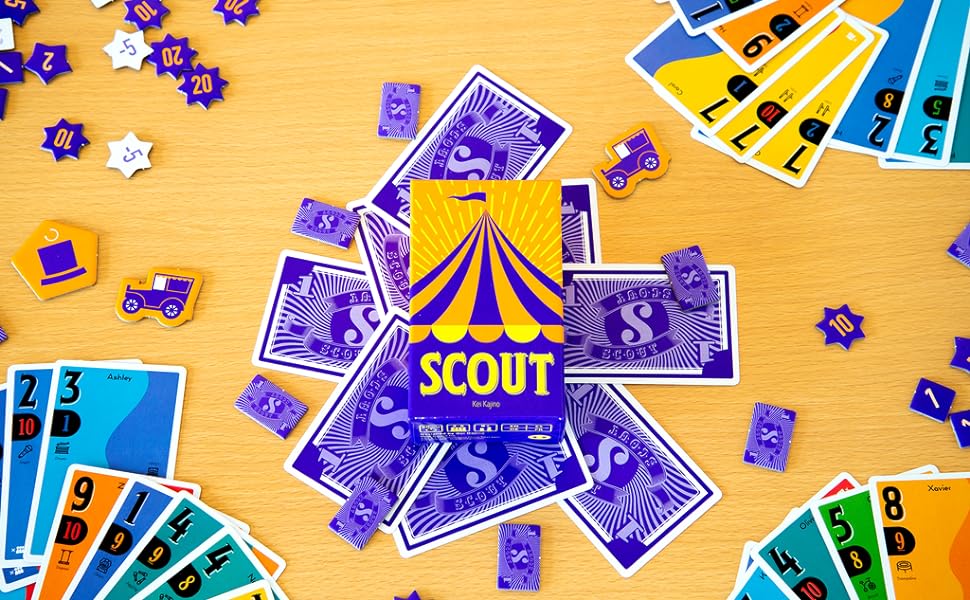
This month’s Game of the Month is one that I first played back in June; Scout, from Oink Games. Soon thereafter, I picked up a copy for myself and have played quite a few games of it. I’m really enjoying it and felt it was a good choice for July’s Game of the Month. Let’s take a look!
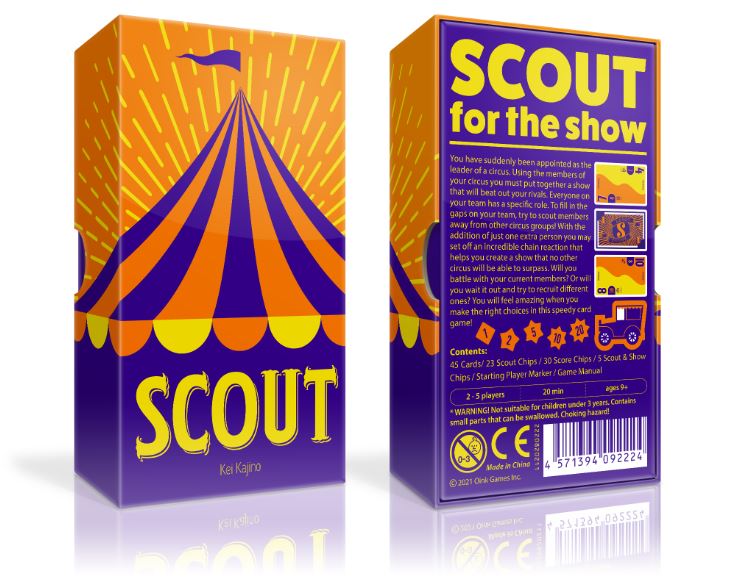
Scout is an intriguing little game. For one, it’s neither European nor American, being published by Japanese publisher Oink Games. Oink Games has been making waves for some time with its bright, iconic small-box board and card games. Let’s run through what you need to know about Scout…
Scout costs a bit more than expected for a deck of cards, but it’s hard not to recommend. Even seasoned strategy gamers need a break, and Scout provides a refreshing experience with just enough nuance to keep players coming back for “just one more match.”
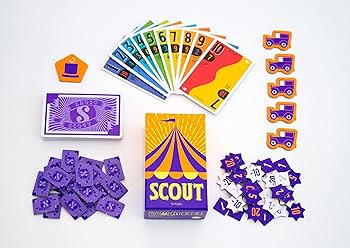
In the wee box, you get a deck of cards and cardboard tokens, pictured above. Each card features a name and circus act (a nod to the game’s completely unnecessary and irrelevant theme of recruiting circus performers), but these have no gameplay effect. The crucial information lies in the two numbers on each card—one at the top and one at the bottom—ranging from one to ten.
All players receive the same number of cards that, once dealt, sit in a fixed order that cannot be changed. Well, mostly. Players can turn their hand upside-down to activate the other set of numbers on the cards. The order is not changeable, but you do have two options at the start of a round.
The goal is to create sets of the same number or sequential series with no gaps. A player lays down a sequence or set (even a single card), and the next player must beat it with a better sequence or set. Players who are unable to play a better sequence set can instead pass and take a card from the played set (the titular scout action), slotting said card into their hand wherever they want to help them line up future plays. The round ends when all of the players scout in a row without playing, or someone empties their hand. In my experience, the former outcome is far more common than the latter.
The game has a lot going for it. It’s easy to learn with accessible rules, making it great for families and non-gamers. It’s pretty fast-paced: Rounds last around 20 minutes, keeping players engaged. Despite the simplicity, it’s got that Nuanced Gameplay that we love, forcing difficult decisions and fostering real depth and strategy.
I only have two real criticisms of the game. The first is the randomness. You can be scunnered by a bad start. The ability to turn your cards upside down at the start of the game usually gives you a better (read: less bad) option, but it can still feel bad to be stuck from the start. Judicious use of scouting will be necessary here. It’s not something that’s really bothered me thus far, but other players at the table have expressed frustration.
My second complaint is the theming. It’s just pasted on and is ultimately meaningless. I’d rather just not have an attempt at theming, rather than a tokenistic glaze.
I love this game. It’s easy to pick up, and if you’re struggling to teach it before the game, a couple of turns will be enough for folk to get the hang of it. It’s both joyous and infuriating in (almost) equal measure, which is something I like for some reason. For all it costs, go and pick it up. It’s well worth the asking price.
Affiliate Link:
 No Rerolls
Great game, but I’d rather not play it at e players. I would want at least 4.
Had a bad experience at 3.
LikeLiked by 1 person