
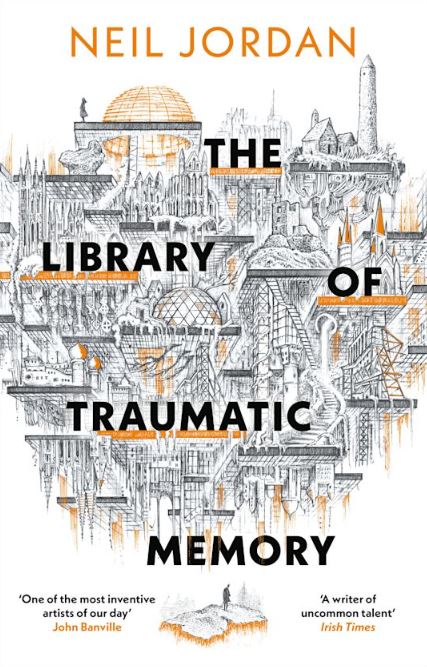
The Library of Traumatic Memory is a sci-fi novel by Neil Jordan and published by Head of Zeus. It was released in March, 2026. This review is intended to be free of spoilers, but none of us are perfect. Consider yourself warned! I was provided with a review copy by the publishers. There are affiliate links at the end of this review.
Blurb
The first literary science fiction novel from Neil Jordan, visionary director of The Company of Wolves and Interview with the Vampire
In a windswept corner of a forgotten peninsula, love and loss echo through the halls of a mansion built on secrets. Here memory is currency of the future, and the past refuses to stay buried.
In the year 2084, Christian Cartwright, a quiet librarian at the enigmatic Huxley Institute, spends his days archiving the world’s most painful memories in the Library of Traumatic Memory.
But when his lover Isolde dies in a mysterious car crash, Christian secretly resurrects her as a digital consciousness – an act of grief, obsession, and defiance.
As Christian navigates a world where memories can be edited, dreams harvested, and the dead made to speak, he uncovers a deeper conspiracy buried in the Institute’s foundations – one that stretches back centuries to his 18th-century ancestor Montagu Cartwright, the architect of the Huxley Mansion.
Montagu’s obsidian mirror and copper model may hold the key to a reality where architecture shapes fate and time loops back on itself.
Blending gothic mystery, speculative science, and philosophical depth, The Library of Traumatic Memory is a haunting meditation on love, loss, and the ethics of memory.
As the past and future collide, Christian must decide what it means to remember – and what it costs to forget.
Review
Neil Jordan has always been a master of the atmospheric and the uncanny. From The Crying Game to my beloved Interview with the Vampire, his ability to blend the gothic with the deeply personal is undisputed. In The Library of Traumatic Memory, Jordan sets up a premise brimming with potential: a surreal, architectural manifestation of the pain we carry. Unfortunately, while the prose is as elegant as ever, the narrative feels like a beautiful engine that never quite shifts into gear.
Jordan definitely has a gift for imagery. The library itself is a hauntingly realised concept; a sprawling, shifting repository where memories are inhabited rather than merely remembered. His exploration of how trauma fragments the self is interesting, and there are passages here that possess a genuine, ghostly beauty. For the first fifty pages, the dreamlike quality of the writing is enough to carry the reader through the fog.
The difficulty lies in the transition from concept to story. As the novel progresses, the internal logic becomes increasingly opaque. While the disjointed structure is clearly a stylistic choice meant to mirror the nature of PTSD, it can create a significant barrier for the reader. The idea is worthy, but it just doesn’t quite work.
The protagonist’s journey through these fractured memories feels strangely passive. We move from one vivid, traumatic vignette to the next, but the emotional stakes remain static. Without a clearer narrative anchor or a sense of forward motion, the lyricism begins to feel repetitive. I found myself admiring the sentences while simultaneously feeling disconnected from the soul of the story.
This isn’t a bad book. Jordan is too skilled a craftsman for that. Rather, it is a frustrating one. The book leans so heavily into its abstract aesthetic that it loses the human pulse required to make a story about trauma truly resonate.
Pacing is another issue. Despite its relatively slim page count, the circular nature of the plot makes the reading experience feel much longer than it actually is. Again, it feels like an experiment that just didn’t quite work out.
Ultimately, The Library of Traumatic Memory feels like a mood piece that prioritises metaphor over map. If you enjoy experimental, vibes-based fiction that ignores traditional plot structures, you may find beauty in these stacks. However, for those looking for the narrative depth Jordan usually provides via other mediums, this feels like a missed opportunity; a stunningly decorated room that remains unfortunately empty.
Rating: 2/5
 No Rerolls