
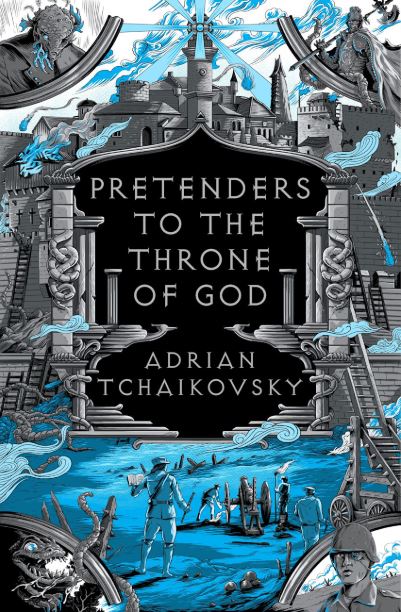
Pretenders to the Throne of God is a fantasy novel by Adrian Tchaikovsky and published by Head of Zeus. It was released in February, 2026. This review is intended to be free of spoilers, but none of us are perfect. Given that this is a sequel, it may contain indirect spoilers for the previous books in the series. Consider yourself warned! I was provided with a review copy by the publishers. There are affiliate links at the end of this review.
Blurb
Arthur C. Clarke winner and Sunday Times bestseller returns to a world steeped in magic – and the Tyrant Philosophers’ campaign to bring reason, logic and ‘perfection’ to it.
As the Palleseen’s campaign to bring Perfection and Correctness to an imperfect world rages on, Eres Ffenegh – “the City on the Back of a Crab” – is the next state slated for conquest. But its citizens won’t give up sovereignty easily.
The siege has dragged into winter and the defenders – both locals and Pal renegades – hold an uneasy alliance against the enemy at the gates, while the Pal army is looking over its shoulder for the next self-destructive dictate of their government back home.
Within the city, Devil Jack, a good man apprenticed to the notorious conjurer known as the Widow, is driven to bargaining with hell to get back what he’s lost. Meanwhile Kiffel ea Leachan is the city’s champion, a child of privilege who’s just lost everything to the invaders. Both must try to survive the siege and make their own destinies in a world that’s cut them loose.
Outside the city, Pal reinforcements have arrived to take the city, but it’s the sort of help that might just damn them all…
Review
Pretenders to the Throne of God is Adrian Tchaikovsky at his most confident. It’s a siege novel that feels vast and intimate at once, built from a mosaic of perspectives that somehow lock together with unnerving precision. Eres Ffenegh, the city on the back of a dead crab, is a living pressure cooker. You can taste the brine in the air, feel the weight of dwindling supplies, and sense the way the siege grinds people down into versions of themselves they never expected to become.
Tchaikovsky’s gift for character work is on full display. The returning cast is handled with a deftness that rewards long‑time readers without ever feeling like a roll call. Jack – Happy Jack, Maric Jack, Yasnic, Devil Jack – is extraordinary here. His arc is equal parts tragic, funny, and quietly devastating, and the way his personal choices ripple outward into the fate of nations is one of the book’s sharpest through‑lines. The fact that he’s still, fundamentally, the man who never wanted any of this makes his impact all the more powerful.
The new characters are just as compelling: the luckless champion Kiff; the girl whose ancestral sword has been emptied of its guiding spirit; the Palleseen irregulars who know they’re indispensable and ideologically unacceptable at the same time. Even the demons feel startlingly human. No one is simple. No one is safe. And no one escapes the consequences of their own compromises.
Thematically, this is some of Tchaikovsky’s strongest work. The cracks in the Palleseen project, including the purges, the ideological tightening, the desperate attempts to erase the very irregularities that won them their victories, are handled with chilling clarity. The book understands how authoritarian systems eat themselves, and how ordinary people get caught in the gears. The siege becomes a lens for everything the series has been circling: perfection as violence, belief as contagion, liberation as both salvation and terror.
Structurally, the novel is a marvel. The shifting viewpoints, the “mosaic” battle chapters, the way tiny, throwaway moments from earlier books suddenly detonate into significance… It’s all executed with a confidence that makes the world feel enormous and lived‑in. Eres Ffenegh is, once again, a character in its own right, its streets and factions and grudges forming a kind of living map of the series’ accumulated history.
And when the book goes deeper into fantasy, it really embraces the genre, complete with lich queens, gods leaking back into the world, the Kings Below, and a romance conducted across the borders of Hell. Yet none of it ever overwhelms the human core. The spectacle lands because the people do.
The ending is explosive, surprising, and deeply satisfying. It’s the kind of finale that recontextualises the whole series while setting the stage for the return to Ilmar in The Grave of Perfection, the next planned book in the series, and the finale. If Tchaikovsky sticks the landing, this might well become his finest series.
Pretenders to the Throne of God is brutal, clever, bleakly funny, and endlessly humane. A masterpiece of character‑driven epic fantasy, and the strongest entry in the Tyrant Philosophers saga so far.
Rating: 5/5
 No Rerolls