

Every so often, a game sneaks onto the table and surprises you; not with grandiose components or epic campaign arcs, but with elegant design, satisfying combos, and a dash of magical mischief. Arcane Academy, designed by Eric Lang and Kevin Wilson, is exactly that kind of game. It’s fast, clever, and endlessly replayable; a perfect pick for this month’s spotlight.
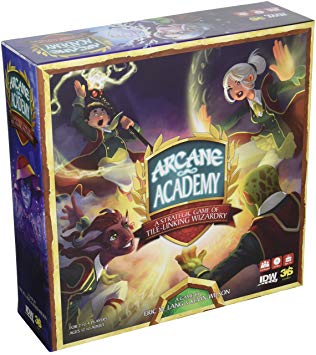
It’s actually a game that used to make it to the table a lot more. When I first played it, I immediately went and ordered a copy. It was good, in recent weeks, to revisit the game.
At its heart, Arcane Academy is a tile-laying, engine-building game where players are students at a school of magic (not that one), racing to complete assignments and earn prestige. Each player builds a personal slate or board of action tiles, carefully linking them to chain powerful effects. Once a tile is used, it’s exhausted; so timing and planning are everything.
For me, the joy of the game lies in its combo potential. Activate one tile, and if it’s linked to others, you can trigger them too, sometimes setting off a cascade of actions that feels like pulling off a perfectly executed spell. It’s a mechanic that’s easy to learn but deeply satisfying to master, and there’s nothing better than getting a big, consequential turn because of good grid placement.
Assignments come in two forms: spells, which offer one-time effects, and items, which provide ongoing abilities or end-game points. The goal of the game is to complete assignments to get points, which are called prestige. Once somebody gets to 8 completed assignments, the game enters its final turn. Deciding when to invest in a quick spell versus a long-term item is a constant balancing act. And because each player has private goals in addition to public ones (there are four visible, shared assignments, and each player also maintains a hand of three hidden, personal assignments), there’s always a layer of hidden strategy at play.
Despite its light ruleset, Arcane Academy offers meaningful decisions every turn; which is really crucial for me when it comes to enjoying a game. Do you rest to refresh your exhausted tiles, or push your luck for one more combo? Do you grab a powerful tile from the market, or complete a low-cost assignment to edge closer to the game’s end? You’re going to have some underwhelming turns, but you need to make sure that these are in service of setting up a better turn in the future.
One of the game’s greatest strengths is its accessibility. With a 30–45 minute playtime and intuitive mechanics, it’s a fantastic choice for families, casual gamers, or anyone looking for a quick but crunchy experience. Yet it never feels shallow, largely thanks to the clever tile-linking system and the variety of assignment cards. There’s always room to explore new strategies. Personally, I like setting up items to benefit from other players taking rests. Oh, you’ve rested? I’ll remove exhaustion from my board! Oh, and let’s grab a shard and some willpower, too! This is my favourite way to play, and it’s what I’ll generally work towards if I can get the right assignments early enough.
Arcane Academy is an underrated gem that deserves more love. It’s a game that rewards clever planning, encourages some small level of interaction, and delivers that “just one more game” feeling in spades. Whether you’re an experienced gamer looking for lighter fare or just dipping your toes into engine-building games for the first time, this magical little title is well worth a spot on your shelf.
 No Rerolls
8 Comments