
Late July. London was warm, the streets buzzing, and I walked into the Lyric Theatre with high hopes. They were met. And then some. Hadestown isn’t just a musical; it’s a ritual. A retelling. A reckoning. It’s the kind of show that grabs you by the heart and doesn’t let go, even after the final note fades. I’ve seen plenty of theatre. This was the best.
This review will include spoilers.
The moment Allie Daniel (who usually plays a Fate) stepped out in that silver waistcoat as Hermes, I knew I was in for something different. “Road to Hell” hit like a prophecy; howling brass, stomping rhythm, and a chorus that felt like it had crawled out of the earth. The band wasn’t just playing. They were conjuring.
Anaïs Mitchell’s score has evolved into something mythic. It’s folk, jazz, blues, and something else; something ancient. Every song feels like it’s been sung for centuries, even if it was written yesterday. “Wait for Me” was a gut punch. “Why We Build the Wall” felt terrifyingly timely. And “Our Lady of the Underground”? Funky, furious, and unforgettable.
My favourite song of the night was “Why We Build the Wall”, and Chris Jarmin’s voice made it unforgettable. His Hades didn’t shout or snarl. He resonated. That deep, buttery tone rolled through the theatre like thunder wrapped in velvet, commanding attention without ever raising volume. The song itself, written by Anaïs Mitchell back in 2006, feels eerily prescient, long before political walls became global headlines. It’s a chilling anthem of control disguised as protection, and Jarmin delivered it with terrifying calm. The repetition, the logic, the seduction; it all felt too real. In that moment, Hades wasn’t just a god. He was every voice that ever told us fear was safety. And the fact that this song predates its real-world parallels makes it all the more haunting. Here’s a performance of the song by the Broadway cast:
The set is a masterclass in minimalism. A New Orleans-style bar that becomes a factory, a mythic crossroads, and the gates of hell. The revolve spins like fate itself, pulling characters deeper into the story. The choreography is tight, industrial, and haunting; like the workers of Hadestown are dancing to survive.
My favourite feature of the set would have to be the lanterns. There’s this moment in Hadestown when the lanterns descend for the first time, and that’s fine, until they start to swing, and it’s like the whole theatre holds its breath. They’re just simple hanging bulbs, but when they move, they change everything. It starts slow, one, then another, and suddenly they’re all in motion, sweeping across the stage like a tide. You don’t know whether to feel mesmerised or uneasy. They cast these long, shifting shadows that make the space feel deeper, older, almost sacred. It’s like watching time swing back and forth, or fate teasing its way toward you. And the way they move with the music… It’s not flashy, it’s ritualistic. You feel it in your chest. Like something ancient is waking up.
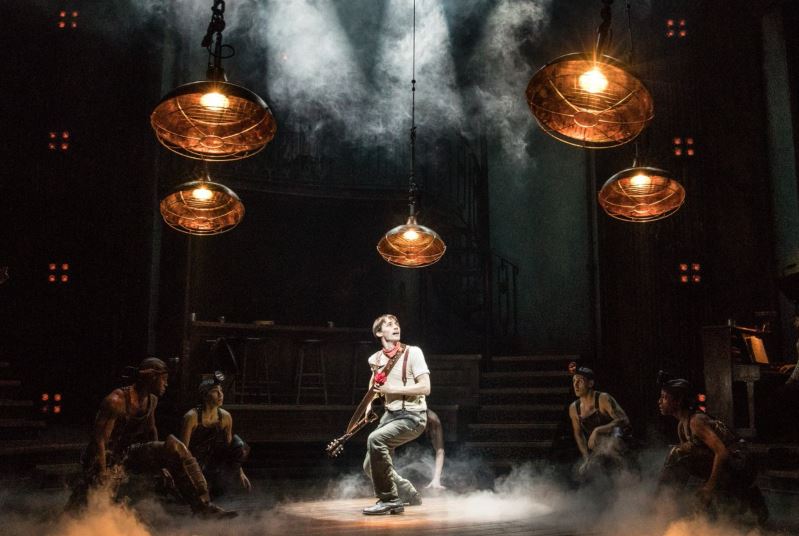
The Lyric Theatre’s intimacy is a gift. You’re not watching from a distance. You’re in it. When Eurydice makes her choice, you feel the chill. When Orpheus sings, you believe he might just change the world.
Sebastiam Lim-Seet was our Orpheus. He was fragile, fey, and utterly sincere. As a Scot, hearing Orpheus speak and sing in a Scottish accent felt like coming home. There was something deeply comforting in it; an honesty, a warmth, a kind of melodic vulnerability that made his hope feel more personal, more grounded. It stripped away the mythic distance and made his longing feel local, familiar, like someone you might know. That accent didn’t just suit the character; it transformed him. Orpheus wasn’t some lofty poet from ancient Greece. He was a dreamer from down the road, singing his heart out in a world that doesn’t always listen. And that made his journey all the more heartbreaking.
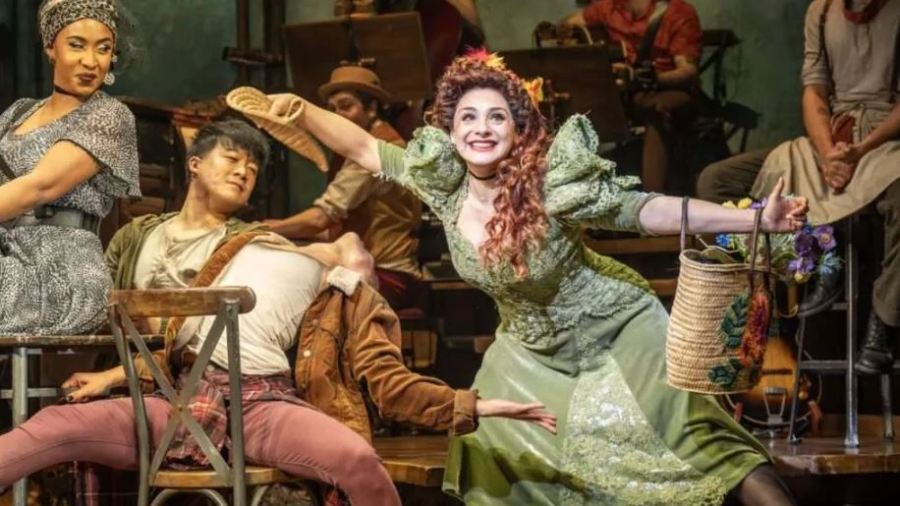
Desmonda Cathabel’s Eurydice is fierce, grounded, and heartbreakingly real. Their chemistry is raw; two souls trying to hold onto each other in a world built to tear them apart. Chris Jarman’s Hades is velvet and steel; seductive and terrifying. Victoria Hamilton-Barritt’s Persephone is fire and funk, her descent into bitterness palpable. And the Fates? They’re always there, harmonising doom with eerie precision.
But it’s Hermes who holds it all together. Hermes is the soul of Hadestown; the storyteller, the guide, the keeper of memory. They don’t just narrate the myth; they frame it, shape it, and carry its emotional weight. Allie Daniel’s performance brought a fresh, electric energy to the role. Their Hermes wasn’t just wise and witty; they were deeply human, a figure who’s seen this story play out countless times and still dares to hope for a different ending. There’s a weariness in Hermes, yes, but also resilience. They’re the one who reminds us why we tell the story, even when it hurts. And in Daniel’s hands, that reminder felt urgent, tender, and true.
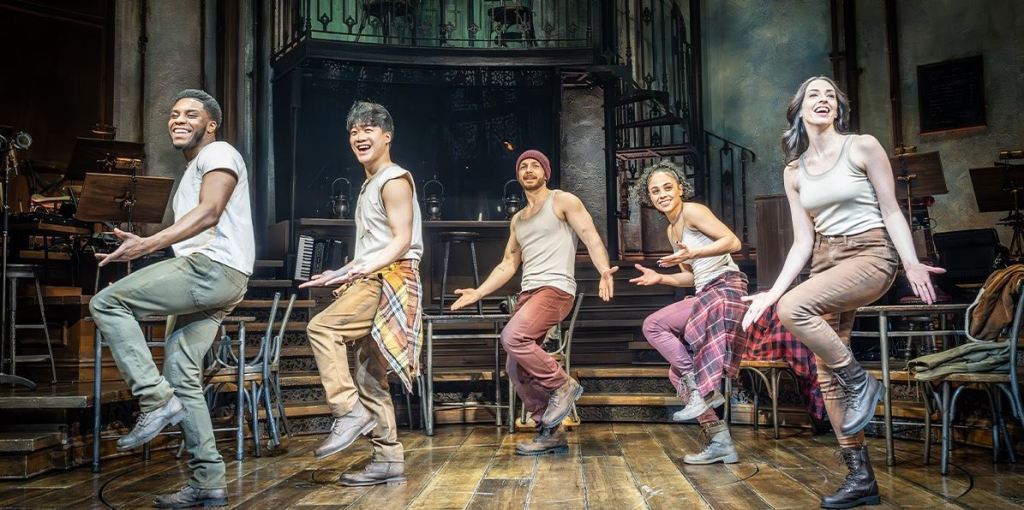
You know how it ends. That’s the point. Hadestown is about love, loss, tyranny, and hope. It’s about why we keep telling the same stories, even when they break our hearts. It’s about the power of music to make us feel it all, again and again.
Let’s talk about that ending. Let’s talk about that reset; about the stage being reset and the initial scene being performed once more. You see, Hadestown isn’t just a retelling of a myth. It’s a play about the act of retelling itself. The actors aren’t portraying Orpheus, Eurydice, Hermes, or Hades. They’re portraying players; storytellers caught in an eternal loop, performing this tragedy over and over, knowing how it ends, but daring to hope that this time, maybe this time, the song will change. It’s all heartbreakingly meta. The repetition isn’t just narrative; it’s ritual. A collective act of resistance against despair. When Hermes says, “spring had come again, with a love song,” it’s not just a line. It’s a prayer. A reminder that even in the face of inevitable loss, we keep singing. Because the telling itself is an act of hope.
As the curtain fell and the story reset, I sat there stunned. Not because I didn’t know what was coming; but because I felt it. Deeply. Personally. Is it clear that this is a strong recommendation?
 No Rerolls
For sure, loved Hadestown since seeing the US Tour November 2022. First time seeing it was in the orchestra. But what originally got me fascinated it was the 2019 Tonys, but what furthered this fascination was discovering it was based off of Greek Mythology
So, this show has two loves of mine- musical theatre and Greek Mythology. Hermes probably is the narrator of the show because he is the messenger of the Gods in Greek Mythology.
LikeLiked by 1 person