

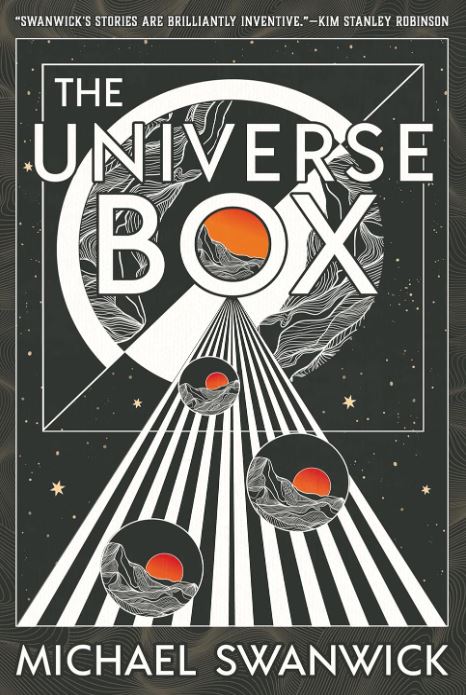
The Universe Box is a short story collection by Michael Swanwick and published by Tachyon Publications. It is due toi be released in February 2026. This review is intended to be free of spoilers, but none of us are perfect. Consider yourself warned! I was provided with a review copy by the publishers. There are affiliate links at the end of this review.
Blurb
Discover the vast worlds and pocket universes of Michael Swanwick (Stations of the Tide), the only author to win science fiction’s most prestigious award five times in six years. In his dazzling new collection, the master of speculative short stories returns with tales in which magic and science improbably coexist with myth and legend. With two stories original to this collection, Swanwick aptly demonstrates with poignant humor why he is widely respected as a master of imaginative storytelling. In engaging stories, Mischling the thief races through time to defeat three trolls before the sun rises for the first time and turns the inhabitants of her city into stone. A scientist is on the run from assassins, because her research in merging human intelligence with sentient AI is too dangerous. An aging veteran obtains a military weapon from his past: a VR robotic leopard in which he rediscovers the consequences of the hunt. In the biggest heist in the history of the universe, a loser Trickster (and the girlfriend who is better than he deserves), sets out to violate every trope and expectation of fiction possible.
Review
Michael Swanwick’s The Universe Box is a curious, playful collection of short stories that reminds us why he has remained a fixture in speculative fiction for decades. The premise of the title story – a box that contains “practically the entire universe” – is quintessential Swanwick: audacious, whimsical, and tinged with danger. It sets the tone for a book that delights in bending rules, mixing genres, and inviting readers to peer into worlds that feel both familiar and utterly strange.
What works best here is Swanwick’s imagination. He has a knack for conjuring settings that feel like miniature laboratories of possibility, where science and myth collide in unexpected ways. His humour, too, is ever-present, keeping the collection buoyant even when the subject matter veers toward mortality or cosmic dread. There are moments when his wit feels like a sly wink to the reader, a reminder that speculative fiction can be both profound and fun.
That said, the collection is uneven. Some stories sparkle with invention and emotional resonance, while others feel more like sketches; clever ideas that never quite bloom into full narratives. The shifts in tone and genre, while admirable in their variety, can leave the book feeling fragmented. Readers looking for a cohesive arc may find themselves wishing for stronger connective tissue between the pieces.
Still, The Universe Box is not without charm. It’s the kind of book that rewards dipping in and out, savouring the imaginative premises rather than expecting a grand unified statement. For longtime Swanwick fans, it’s another chance to enjoy his singular voice; for newcomers, it may serve as a lighter introduction to his work rather than a definitive showcase.
In the end, The Universe Box is a respectable offering: inventive, witty, and enjoyable, but not quite essential. It’s a reminder of Swanwick’s enduring creativity, even if it doesn’t reach the heights of his most memorable collections.
Rating: 3/5
 No Rerolls
2 Comments