

And then, dear friends, it was September. Ooft. With that comes August’s Game of the Month, along with the customary review. This time we’re looking at Tiny Towns, a game I first played a few months back, purchased in July, and have been playing with some regularity.
Tiny Towns, designed by Peter McPherson and published by AEG, is a thoughtful and engaging game that combines elements of strategy, spatial planning (not my forté…), and resource management. Released in 2019, it quickly gained popularity for its accessible gameplay and charming aesthetic. Seating 1 to 6 players, Tiny Towns offers a fun, if delightfully frustrating, gaming experience for a pretty broad audience. Certainly, I’ve enjoyed this with experienced board game players and newer or more casual players.
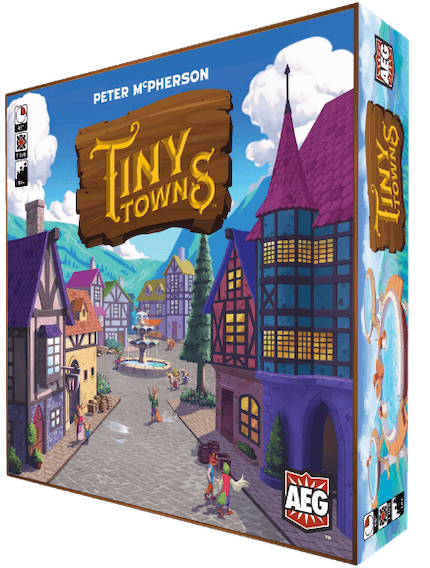
In Tiny Towns, players step into the roles of town planners striving to create the most prosperous and efficiently organised town on their personal 4×4 grid. The game features a clever and ever-evolving puzzle where players must strategically place buildings to optimise their town’s layout and maximise one’s potential points.
The heart of Tiny Towns lies in its resource management and spatial puzzle mechanics. Players start with a vacant 4×4 grid and a communal line of building cards. These cards define the rules for each building type (houses, wells, taverns, and more) in a specific game. Changing the combinations of these cards from game to game changes how you build your board and gives a level of variety and replayability. These buildings require different combinations of resources to be constructed.
Here’s the catch: players don’t have direct control over which resources they receive. Instead, the resource selection is dictated by a designated player, rotating each turn, called the Master Builder, who calls out a resource type. All players, including the Master Builder, must then place that resource on their grid, trying to strategically accommodate it into their town’s layout. Resources should be place in specific combinations which can then be traded in for buildings.
The game introduces clever card abilities, resource management, and town optimisation. Players need to plan ahead, anticipating the placement of future buildings and how they’ll interact with existing structures. Successful towns efficiently combine buildings to score points through different criteria, such as forming specific shapes, creating sets of buildings, or optimising resource production.
Tiny Towns is a remarkable blend of accessibility and depth. Its simple rules make it easy for newcomers to grasp (my mum managed it, so that’s a ringing endorsement!), but the strategic depth and decision-making opportunities provide a satisfying challenge for experienced gamers. The game’s elegant design ensures that every choice counts, making it easy to become engrossed in creating the perfect tiny town.
The resource management mechanic, with the rotating Master Builder role, adds a layer of player interaction and tension. Players must adapt their plans based on the resources they receive, creating a delightful blend of strategy and adaptability. It also means that every game is unique, as resource availability varies, keeping the gameplay fresh and engaging.
One of Tiny Towns’ strengths is its scalability. It works well for both solo play and larger groups, thanks to rules that accommodate different player counts. This adaptability ensures that Tiny Towns can be a go-to choice for various gaming scenarios.
The game’s components are simple but visually pleasing. The building cards feature charming artwork, and the wooden resource tokens and buildings add a tactile and aesthetic appeal. The compact 4×4 grids give players a sense of accomplishment as they fill their towns with a variety of buildings. For the components in the box, the game does feel a little overpriced, but I enjoy the game enough to not begrudge this too much.
The only other potential downside is that Tiny Towns can be mentally taxing and, if you’re having a bad game, quite frustrating as players strive to optimise their towns. This might not suit every gaming group, as some players may find it more infuriating than relaxing.
Tiny Towns is a gem of a tabletop game. Those accessible rules give way to the satisfying experience of building your (tiny) town. I think it’s a pretty worthy choice for this month’s featured game.
 No Rerolls
Tiny towns is one of our go-tos for a quick(ish) game
LikeLike