

The Eye of Atlas is a sci-fi novel by Juse McKenna. It was first published in February 2025 by Liminal Horizon Press. This review is intended to be free of spoilers, but none of us are perfect. Consider yourself warned! A review copy was provided by the publisher. There are affiliate links at the end of this review.
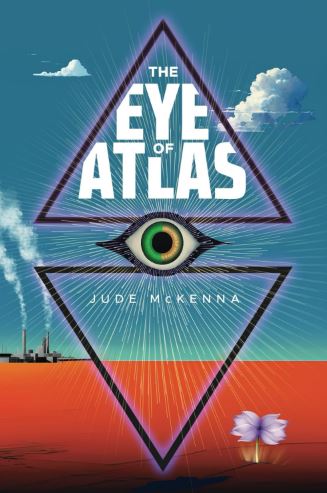
Blurb
Welcome to Atlas.
The once-thriving city is a shell of its former self, laid waste by Sahara, the world’s largest (and only) megacorporation. Shimmering skyscrapers cast shadows over vast stretches of corporate slums and crumbling pavement.
Here, Malcolm McCormick, a twenty-year-old daydreamer, works a dead-end job at a marble factory. Employees are closely surveilled with state-of-the-art technology, including AI-powered collars that punish those who fall out of line.
For Malcolm, every day is the same monotonous slog . . .
Until he happens upon Evie, a savvy coworker who is struggling to keep her family off the streets.
Unbeknownst to them, this seemingly ordinary encounter rips a hole in the veil between realities. Strange things follow: electrical aberrations, out-of-body experiences, messages from the deceased. Stranger still, these events point to a dark secret hidden beneath the factory, one that could expose Sahara’s seedy underbelly.
As they peel back the layers, Malcolm and Evie find themselves plotting to overthrow their corporate overlords. But as tensions escalate, so do the supernatural phenomena. Following clues from a dead coworker’s journal, they plunge into the unknown depths.
It’s only when they reach the bottom that they realize there’s no turning back.
Review
The Eye of Atlas thrusts readers into a near-future metropolis consumed by corporate dominion. In Atlas, Sahara – the sole megacorporation – monitors every breath with AI‐powered shock collars and draconian quotas, reducing human lives to unceasing labour. Amid this sterile surveillance, twenty-year-old dreamer Malcolm McCormick toils at a marble factory until a chance meeting with coworker Evie rips open a portal between realities. From that moment, the mundane and the supernatural collide in a relentless race to uncover a buried truth.
Let’s start with the setting. Atlas is not a backdrop but a living, suffocating character. The city’s gleaming towers cast long shadows over crumbling slums, embodying stark inequality; we do love a good metaphor. In the heart of Atlas, silence isn’t peace but a verdict: the low hum of conveyor belts and the soft click of shock collars speaking louder than any shout. Fluorescent lights drip an unending white glare over marble slabs, each one forged by hands that know the sting of quotas more intimately than warmth. Here, corporate banners aren’t propaganda—they’re scripture, dictating the rhythm of breath and heartbeat. Every footstep echoes down antiseptic hallways patrolled by AI eyes, reminding workers that even a whisper of dissent becomes a measurable offence. In this muted symphony of control, humanity is reduced to data points, and hope flickers like a dying bulb on the brink of total shutdown.
In Atlas, the labyrinthine corridors and pixelated billboards echo the omnipresent gaze of our real-world cameras, the algorithms sorting our faces as we navigate rent hikes and endless commutes. The AI collars and quota-driven shifts mirror the precarity of gig-economy labour, where every missed punch-in carries real consequences. Yet beneath the corporate sheen, small acts of defiance – glued flyers in hidden stairwells, whispered alliances in cramped kitchens, shared playlists smuggled through the network – mirror the guerrilla art, pop-up clinics, and mutual-aid pods that animate our own city streets. Atlas reminds us that even when steel towers loom and data streams consume, collective resilience threads its way through the underground, proving that solidarity remains the most potent form of subversion.
McKenna’s world‐building balances gritty detail with some poetic resonance, ensuring the reader feels both the grime under Malcolm’s fingernails and the oppressive hum of corporate propaganda.
In terms of characters, Malcolm’s wearied optimism and Evie’s resourceful grit forge an instantly relatable duo. Malcolm’s daydreams anchor him to a humanity that Sahara strives to erase, whilst Evie’s fierce loyalty to her family fuels her quiet courage. Their evolving partnership cracks open not only factory floors but also the walls around their hearts. Their banter is spare, yet charged, and McKenna allows moments of genuine warmth to puncture the novel’s pervasive bleakness.
I love the start of this novel, where we are introduced to the corporate horror that is Malcolm’s day-to-day existence. However, just when the narrative feels tethered to that corporate horror, McKenna introduces electrical anomalies, out-of-body visions, and spectral messages. These phenomena aren’t mere set dressing; they heighten every moral choice. As Malcolm and Evie descend into Atlas’s hidden depths, the supernatural elements seamlessly amplify the stakes, transforming a social thriller into an existential quest.
Beneath its pulse-pounding plot, The Eye of Atlas asks urgent questions about agency, memory, and resistance.
- What is worth sacrificing when every action is watched?
- How do we reclaim identity in a world that bills us for basic necessities?
- Can hope survive in a city designed to crush it?
McKenna’s critique of unchecked capitalism resonates disturbingly close to today’s headlines, yet she never reduces Atlas to mere allegory. The metaphysical twists remind us that even under the harshest yoke, the human spirit can fracture – and also transcend – its chains.
Rating: 4/5
 No Rerolls
2 Comments