
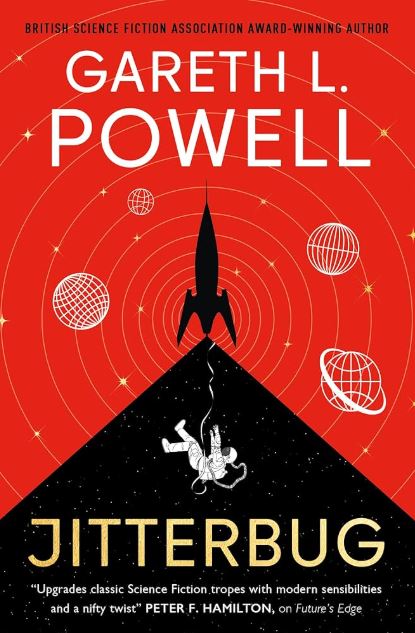
Jitterbug is a sci-fi novel by Gareth L. Powell and published by Titan Books. It is due to be released in March 2026. This review is intended to be free of spoilers, but none of us are perfect. Consider yourself warned! I was provided with a review copy by the publishers. There are affiliate links at the end of this review.
Blurb
“On Earth, they depicted justice as blindfolded and impartial, but out here on the frontier, she was red in tooth and claw.”
Jupiter and Saturn are gone, and a mysterious force has built a huge habitable sphere from their ashes. When criminals try to lose themselves on this new frontier, bounty hunters like Copernicus Brown and the crew of his sentient ship Jitterbug get paid to hunt them down.
But when Brown rescues Amber Roth, sole survivor of a pirate attack, the Jitterbug and her crew find themselves the target of powerful political factions who want control of the data chip hidden in Roth’s stomach.
And all the while, something vast and ancient creeps towards them from the depths of space…
Review
Gareth L. Powell’s Jitterbug is a fast, exuberant space‑opera adventure that hits the ground running and rarely looks back. From the opening pages – a prologue that delivers cosmic catastrophe with startling immediacy – the novel establishes a tone of high‑energy spectacle. Once the story shifts to Copernicus Brown and his bounty‑hunting crew aboard the semi‑sentient ship Jitterbug, the book settles into a rhythm that some may describe as a “romp”: short chapters, rapid POV shifts, and a narrative that prioritises momentum over introspection. It’s a book that knows exactly what kind of ride it wants to be, and it commits to that vision with confidence.
The worldbuilding is the novel’s standout strength. The Swirl, a solar‑system‑spanning megastructure built from the dismantled gas giants, is one of those big, audacious SF ideas that immediately sparks the imagination. Powell sketches a future where humanity is still taking its first tentative steps into space, colonising the interior surfaces of these vast Dyson‑plate segments while trying to understand the alien forces that created them. The setting is inventive and full of narrative potential. It’s the kind of backdrop that evokes Firefly, Cowboy Bebop, Guardians of the Galaxy, and even the early Expanse novels, but without feeling derivative. The fact that the book doesn’t overexplain its cosmology is demonstrative of a restraint that adds to its charm.
The crew dynamic is another highlight. Copernicus is a likeable, morally grounded protagonist, and the supporting cast, including Kiki, Ulf, and Amber, slot neatly into the familiar rhythms of a ragtag spacefaring team. But the breakout character is unquestionably Jitterbug herself. The ship’s sentient AI, who manifests as a synthetic parrot and receives her own POV chapters, is repeatedly singled out as the most vivid and memorable presence in the book. At times, the ship felt more fully realised than some of the human characters, and that’s not meant as a criticism so much as an acknowledgment of how well Powell handles non‑human perspectives.
Where the novel stumbles a little is in depth and clarity. The same pacing that makes the book so compulsively readable also means it sometimes feels compressed. Jitterbug (the novel, not the character/mode of transport) contains enough material for two or three novels, and the rapid transitions between bounty‑hunter adventure, political conspiracy, and cosmic mystery don’t always have time to breathe. The multiple POVs and timelines, while adding scope, occasionally become confusing, and some readers may find themselves re‑reading sections to keep track of the shifts. Emotional beats, such as the underwhelming romance subplot, feel rushed or underdeveloped. It just feels like character archetypes were developed and then time was never quite allocated to fully flesh them out into multidimensional characters.
The writing style is clean, accessible, and confident. Powell has a knack for delivering big ideas with clarity and for choreographing action scenes that feel cinematic without becoming cluttered. Is the tone too light? Maybe. It does occasionally veer toward YA territory, lacking the emotional weight that the premise could have supported. There’s the occasional stab at a more serious, grounded tone, but these interludes just end up being a bit jarring.
The ending, like the pacing, is somewhat mixed. Many will find it satisfying, twisty, and an appropriately big swing for a novel that deals in cosmic engineering and solar‑system‑scale stakes. That said, I do think it arrived too quickly and wrapped things up too neatly. It was definitely ambitious, and I give it credit for that.
Taken as a whole, Jitterbug is a lively, highly digestible space adventure that delivers exactly what it promises: big ideas, fast action, and a memorable setting anchored by a standout sentient ship. It’s not a novel that lingers on emotional nuance or deep character study, and readers looking for that kind of depth may find it thin. But for those who want a quick, entertaining standalone with inventive worldbuilding, a strong sense of fun, and a cinematic pulse, it hits the mark. It also leaves me hoping Powell might return to this universe with more room to explore.
Rating: 4/5
 No Rerolls
2 Comments