
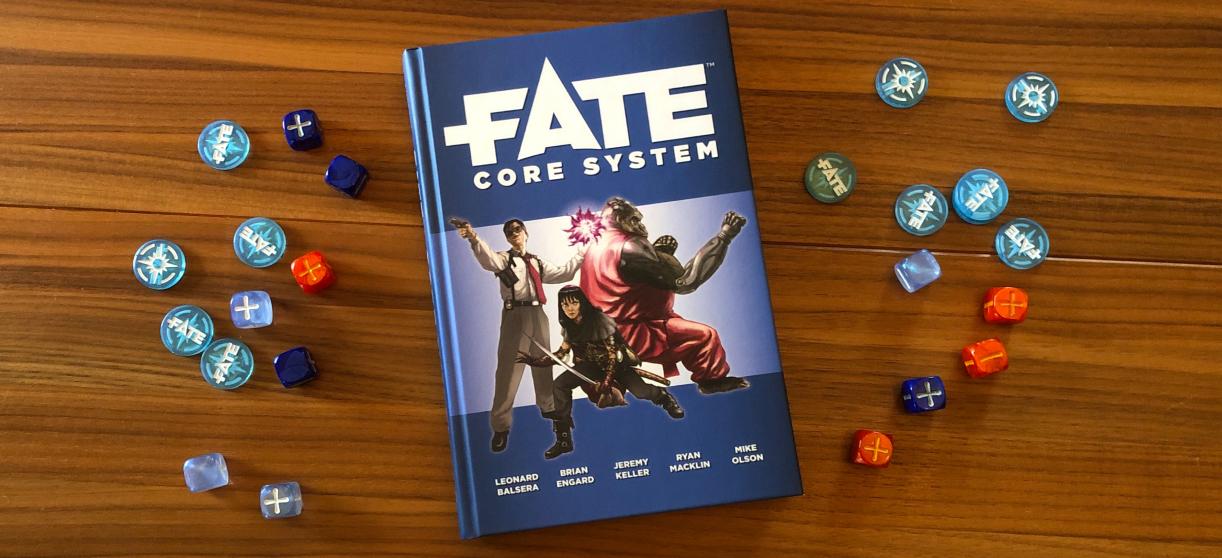
Dungeons & Dragons, and particularly the current fifth edition, is the undisputed champion of the RPG world. It’s what most people think of when they think about roleplaying games, and its usually people’s first introduction to the genre. Not for all of us, of course… And, you know what, it’s a good game. It’s good for what it is. The thing is, for a lot of players, it seems that D&D is all there is. You see so many people looking to adjust the game to fit a particular theme, setting? Or style where there are other games available that will work just as well, if not better. Today, we’re taking a look at one such game, Fate, from Evil Hat.
Let’s take a wee delve into the advantages that Fate RPG can offer over D&D 5E.
One of the most significant advantages of Fate RPG is its emphasis on collaborative storytelling and narrative control. Unlike D&D 5E, where the rules tend to focus more on mechanics and combat, Fate empowers players and Game Masters to actively shape the story together. Fate’s system of Aspects allows players to define key elements of their characters, the setting, and even the plot itself, leading to a more dynamic and engaging narrative experience. Actually, the aspects system is something you might want to even just lift wholesale and incorporate into your 5E games as a compromise to encourage characterful roleplay. I’ve done this previously with groups of kids who were focusing a bit too heavily on the grid-based combat of D&D. It went really well!
While D&D 5E boasts a streamlined ruleset compared to its predecessors, Fate RPG takes simplicity to another level. Fate Core features elegant mechanics that prioritise narrative flow over crunchy rules. The use of Fate Points and the Fate Fractal (treating everything as a character) simplifies gameplay, making it accessible to both new and experienced players alike. Fate’s rules are further streamlined by Fate Condensed and Fate Accelerated, each of which offer progressively streamlined experiences.
In Fate, players have a significant degree of agency over their characters and the story’s direction. Aspects not only serve as character traits but also as narrative hooks that players can invoke to gain mechanical advantages or compel to introduce complications. This level of player empowerment fosters creativity and encourages active participation in shaping the game world.
Unlike D&D 5e, where the GM typically holds sole responsibility for worldbuilding, Fate RPG encourages collaborative worldbuilding among all players. Through the creation of Setting Aspects and the use of the Phase Trio during character creation, players actively contribute to shaping the game world, resulting in a setting that feels rich, vibrant, and deeply interconnected with their characters’ backgrounds. I really like the part of the game, and I feel it works particularly well in the Dresden Files RPG, which uses the Fate system.
While combat certainly plays a role in Fate RPG, the system places a greater emphasis on roleplaying and character interaction than D&D 5e. Fate’s mechanics incentivise players to stay true to their characters’ motivations, beliefs, and flaws, leading to deeper immersion and more meaningful roleplaying experiences. The absence of rigid alignment systems allows for greater character complexity and moral ambiguity, fostering richer storytelling opportunities. Rather than an arbitrary alignment chosen from a grid, you essentially define your own alignment. I love that.
One of the most versatile aspects of Fate RPG is its adaptability to any genre or setting. Whether you’re exploring a gritty cyberpunk dystopia, embarking on a swashbuckling adventure on the high seas, or unraveling mysteries in a Victorian steampunk setting, Fate’s flexible mechanics can accommodate virtually any narrative theme or tone. The system’s modularity and customizable rules make it an ideal choice for GMs looking to explore diverse storytelling opportunities. The plethora of settings that have been developed for it, the system toolkits, and other resources add further modular elements that can be incorporated into your adventures.
While Dungeons & Dragons 5th Edition has rightfully earned its place as a cornerstone of the tabletop RPG community, Fate offers a compelling alternative for players and GMs seeking a more narrative-driven, collaborative gaming experience. I simply wouldn’t use 5E for a campaign that I did not intend to be combat-heavy. Fate fills this niche perfectly, and stands as a testament to the power of storytelling in tabletop gaming; the primacy of character-based rolplaying over mechanical crunch and the cut and thrust of combat. Whether you’re a seasoned veteran or a newcomer to the hobby, Fate invites you to embark on collaborative adventures limited only by your imagination and the time you have available for sitting around a table pretending to be an elf.
 No Rerolls
3 Comments